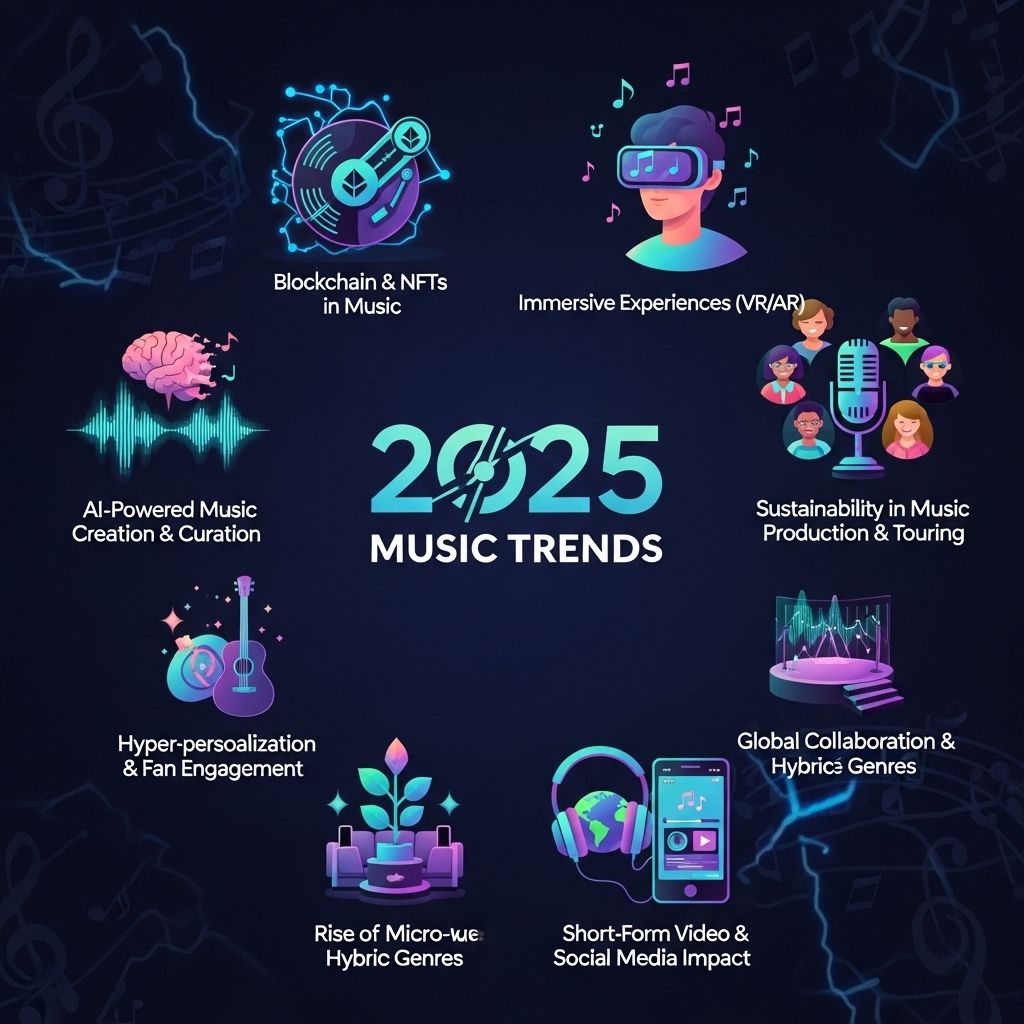
The music trends of 2025 were defined by the full-scale integration of generative AI into creative workflows, the dominance of "Glocal" sounds (global genres with local influences), and a fundamental shift in song structure optimized for short-form video discovery. While 2024 was a year of experimentation, 2025 codified these changes into the new industry standard for production, distribution, and live performance.
As we move through 2026, the ripple effects of the previous year's shifts are evident in every facet of the industry. From the way artists are discovered to the very length of a "radio edit," the 2025 music trends represented a pivotal departure from traditional recording industry models. This retrospective analyzes the technical, cultural, and economic forces that reshaped the musical landscape.
The Normalization of Generative AI and Ethical Co-Creation
By the start of 2025, the debate over whether artificial intelligence belonged in music had largely shifted toward how it should be implemented ethically. The "AI as a threat" narrative was replaced by "AI as a co-pilot," particularly in the realms of production, mixing, and stems separation.
Stem Separation and Remix Culture
One of the most significant technical shifts in 2025 was the ubiquity of high-fidelity stem separation. Tools that allowed producers and fans to instantly isolate vocals, drums, and bass from any track became standard in both professional DAWs (Digital Audio Workstations) and consumer apps. This led to a massive surge in "community remixes," where artists officially released stems alongside their singles, encouraging fans to create their own versions for social media. This trend effectively turned listeners into collaborators, blurring the line between consumer and creator.
AI-Assisted Songwriting and Composition
In 2025, we saw the rise of AI-assisted lyricism and melodic generation as a brainstorming tool. Rather than replacing the songwriter, these tools served to overcome "writer's block" by providing hundreds of variations on a chord progression or a lyrical theme within seconds. However, this also led to a legal "settling" period. The industry saw the implementation of more robust digital watermarking and "Human-Made" certifications to distinguish between purely synthesized content and human-driven compositions.
Ethical Licensing and Voice Modeling
2025 was also the year that major labels and independent artists alike began to monetize their "digital twins." High-profile artists started licensing their AI voice models for use by other creators under strict revenue-sharing agreements. This turned an artist's voice into a scalable asset, allowing them to "feature" on thousands of tracks simultaneously without ever entering a recording studio.
The Rise of "Glocal" and the Decline of Western Hegemony
The globalization of music reached a tipping point in 2025. While "World Music" was once a niche category, the 2025 music trends saw regional genres becoming the primary drivers of global streaming growth. We refer to this as the "Glocal" phenomenon—music that is hyper-local in its cultural roots but global in its production standards and appeal.
The Expansion of the Global South
Genres like Afrobeats and Amapiano continued their upward trajectory, but 2025 saw the emergence of new regional powerhouses. Vietnamese V-Pop and various "Phonk" subgenres from Brazil and Eastern Europe dominated the charts. These genres didn't just stay in their home countries; they influenced the production of Western pop stars, who increasingly sought out producers from Lagos, Seoul, and Mexico City to provide an "authentic" global sound.
Regional Mexican Music’s Global Dominance
Building on the momentum of 2023 and 2024, Regional Mexican music became a top-three global genre in 2025. The fusion of traditional corridos with urban and trap elements (Corridos Tumbados) moved beyond Spanish-speaking markets, proving that language barriers are increasingly irrelevant in a streaming-first world.
Structural Changes: The "15-Second Hook" and Song Compression
Perhaps the most controversial of the 2025 music trends was the continued compression of song lengths. As of 2026, the average length of a Billboard Hot 100 hit has settled significantly below the three-minute mark, a trend that reached its zenith in mid-2025.
Hook-First Songwriting
In 2025, the traditional song structure—Intro, Verse, Chorus, Verse, Chorus, Bridge, Chorus, Outro—was largely abandoned by artists seeking viral success. Songwriters began employing "Hook-First" structures, where the primary catchy refrain appears within the first five to ten seconds of the track. This is a direct response to the "skip" culture of streaming platforms and the 15-second loop requirements of social media platforms.
The Death of the Bridge
The "Bridge" became a casualty of the 2025 music trends. To keep listeners engaged and prevent them from skipping to the next track, producers removed any "lull" or secondary melodic ideas that didn't immediately contribute to the central hook. While this led to highly infectious music, it also sparked a counter-movement of "Long-Form" enthusiasts who turned to genres like Progressive House and Neo-Classical for more complex arrangements.
The Live Music Crisis and the Stadium-Only Economy
The live music landscape in 2025 faced significant challenges, characterized by a widening gap between "superstar" tours and the struggling middle class of artists.
The "Super-Tour" Phenomenon
2025 was the year of the "Residency" and the "Super-Tour." For major artists, the logistical costs of moving massive productions from city to city became prohibitive. Instead, we saw more artists opting for month-long residencies in "hub cities" (Las Vegas, London, Tokyo, Riyadh), forcing fans to travel to them. These events were marketed as "immersive experiences" rather than mere concerts, incorporating VR, AR, and high-end gastronomy.
The Struggle of the Mid-Tier Artist
Conversely, 2025 was a difficult year for mid-tier artists. Rising travel costs, insurance premiums, and the "merch cut" taken by venues made traditional touring unsustainable for many. This led to a surge in "Virtual Touring"—high-quality, ticketed livestream events held in specialized XR (Extended Reality) studios. While these didn't replace the physical concert experience, they became a vital secondary revenue stream for artists with global but dispersed fanbases.
Physical Media as "Looming Collectibles"
Despite the digital dominance, physical media remained a cornerstone of 2025 music trends. However, the purpose of physical media shifted from a playback format to a high-end collectible.
The Vinyl Plateau and the CD Revival
Vinyl sales remained steady in 2025, but the market saw a surprising resurgence in CDs. The lower cost of production and the nostalgic appeal for Gen Z consumers (who view the "jewel case" as a vintage aesthetic) led to a 20% increase in CD sales. Crucially, many of these discs were never actually played; they were sold as "signed artifacts" and pieces of shelf-decor, often bundled with digital download codes and exclusive Discord access.
Sustainable Physical Media
2025 marked the year the industry took a serious stand on the environmental impact of physical media. "Bio-Vinyl" (made from non-petroleum sources) and recycled cardboard packaging became the industry standard. Major retailers began prioritizing eco-friendly pressings, and artists faced public scrutiny if they released multiple plastic-heavy variants of the same album without a clear sustainability plan.
Comparative Analysis of 2025 Music Industry Shifts
The following table outlines the key differences between the traditional music model and the trends that dominated in 2025.
| Feature | Traditional Model (Pre-2024) | 2025 Music Trends |
|---|---|---|
| Song Length | 3:30 – 4:00 Minutes | 2:00 – 2:45 Minutes |
| Discovery | Radio & Curated Playlists | Algorithmic "For You" Feeds & AI Search |
| Production | Studio-bound, Human-only | Hybrid AI-Human, Remote Stems |
| Genre Labels | Rigid (Pop, Rock, Hip-Hop) | Fluid/Hybrid (e.g., Afro-Country, K-Phonk) |
| Touring | 40-City National Tours | Hub-City Residencies & XR Livestreams |
| Revenue Focus | Streaming Royalties | Direct-to-Fan, Merch, & AI Licensing |
| Fan Interaction | Passive Listening | Active Remixing & DAO Participation |
The "Fandom-as-a-Service" Model
One of the most profound shifts in 2025 was the move away from broad streaming reach toward deep fandom monetization. As streaming payouts remained a point of contention, artists turned to "Fandom-as-a-Service" (FaaS) models.
Micro-Communities and Subscription Tiers
Instead of relying solely on Spotify or Apple Music, artists in 2025 built private communities on platforms like Discord, Geneva, or proprietary apps. These "inner circles" required a monthly subscription in exchange for early access to tickets, exclusive "behind-the-scenes" content, and a say in creative decisions (such as which city to tour or which single to release next).
The Integration of Gamification
Music discovery in 2025 became increasingly gamified. Platforms rewarded "super-listeners" with digital badges, virtual assets for gaming environments (like Fortnite or Roblox), and real-world perks. This transformed music consumption from a passive background activity into a competitive social experience.
Frequently Asked Questions (FAQ)
What were the most popular genres in 2025?
In 2025, the most popular genres were Afrobeats, Regional Mexican, and "Drift Phonk," alongside a massive resurgence in Eurodance-inspired pop. The defining characteristic was genre-fluidity; most "Pop" hits in 2025 incorporated elements from at least three different cultural or stylistic origins. This trend was driven by the global nature of social media algorithms that don't categorize music by traditional Western labels.
Did AI replace human songwriters in 2025?
No, AI did not replace human songwriters; rather, it became a standard tool in the songwriter’s kit. While "pure AI" music existed on streaming platforms, it largely functioned as background or functional music (e.g., Lofi beats for studying). Top-charting artists used AI for vocal processing, arrangement suggestions, and data analysis to understand what sounds were trending, but the "human element"—emotional storytelling and personal branding—remained the primary driver of commercial success.
How did the 2025 music trends affect ticket prices?
Ticket prices for major "Super-Tours" and residencies increased in 2025 due to higher production costs and the "experience" premium. However, the rise of virtual XR concerts provided a more affordable alternative for fans who couldn't attend in person. Many artists also implemented tiered "dynamic pricing" models that were more transparent than in previous years, often offering "low-income" tiers or "fan-verified" discounts to combat scalping.
Is vinyl still popular after the 2025 shifts?
Yes, vinyl remained popular in 2025, but it transitioned into a luxury collectible market. The focus shifted toward "limited edition" pressings with unique artwork, colored wax, and integrated digital experiences (like NFC chips that unlock exclusive content). The 2025 music trends emphasized the physical object as a piece of art rather than the primary way to listen to the music.
How did song lengths change in 2025?
Song lengths continued to shorten, with many tracks clocking in between 120 and 150 seconds. This change was driven by the economic reality of streaming—where a play is counted after 30 seconds—and the need for songs to be "meme-able" on short-form video platforms. Bridges and long intros were largely phased out in favor of immediate engagement.
Practical Recommendations for 2026
For artists and industry professionals looking to navigate the landscape left behind by the 2025 music trends, the following actions are recommended:
- Embrace AI Literacy: Understand the ethical use of AI tools for stem separation and production. Artists should consider creating and licensing their own official voice models to maintain control over their "digital likeness."
- Focus on "Hook-First" Content: Whether for social media or streaming, ensure the most compelling part of the track is presented immediately. The "slow burn" is now a luxury reserved for established legacy acts.
- Prioritize Direct-to-Fan Channels: Do not rely solely on third-party algorithms. Build a "home base" on a platform where you own the data and the direct line of communication with your audience.
- Think "Glocal": Even if you are a local artist, consider how your sound can integrate global production trends. Collaborating across borders is no longer a "special project" but a standard growth strategy.
- Sustainability as a Brand: If producing physical media, ensure it meets the 2025-2026 standards for eco-friendliness. Consumers are increasingly making purchasing decisions based on an artist's environmental footprint.
The 2025 music trends were not just a passing phase; they represented a fundamental retooling of the global music machine. As we look forward through 2026, those who have adapted to these hybrid, fast-paced, and globalized standards are the ones currently leading the charts.