Navigating the legal landscape of South Florida requires an intimate understanding of the Eleventh Judicial Circuit of Florida. This comprehensive guide outlines the exact procedures, digital portals, and data access protocols required to successfully execute a Miami Dade County circuit court case search in 2026.
Understanding the Eleventh Judicial Circuit Architecture
The Eleventh Judicial Circuit of Florida serves the entirety of Miami-Dade County, managing an immense volume of litigation ranging from complex commercial disputes to felony criminal matters. Executing a successful case search begins with knowing how the court system categorizes its divisions. The Clerk of the Courts, led by the County Clerk, maintains electronic records across several distinct dockets.
When initiating a search, users must differentiate between county court and circuit court jurisdictions. Circuit courts handle felony criminal cases, family law matters, juvenile dependencies, probate estates, and civil lawsuits where the disputed amount exceeds fifty thousand dollars. Understanding this distinction prevents wasted time searching minor civil or misdemeanor dockets that belong in county court systems.
Operational Jurisdiction Note Official records for Miami-Dade County are governed by Florida public records laws, ensuring broad public access while maintaining statutory restrictions on sealed, expunged, or confidential juvenile and domestic violence files.
Official Digital Portals and Access Methods in 2026
The primary gateway for public record retrieval is the Miami-Dade County Clerk of Courts online portal. As of 2026, the digital infrastructure has evolved to support advanced search parameters, multi-factor authentication for registered legal professionals, and streamlined guest access for pro se litigants and researchers.
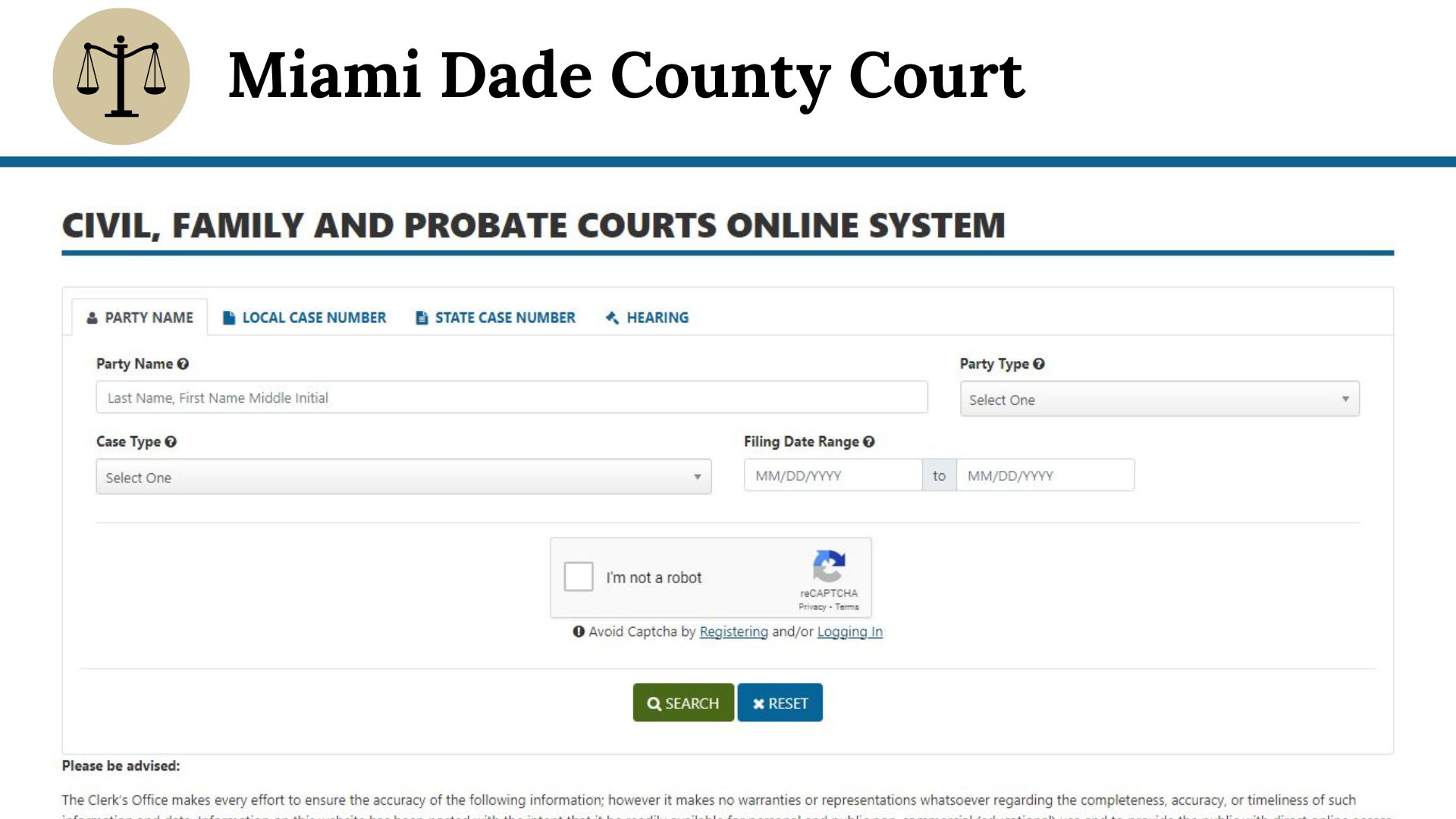
- Online Clerk Case Search: The web-based portal allows searches by party name, case number, uniform case number (UCN), citation number, or attorney bar number.
- In-Person Public Terminals: Physical kiosks located at the Lawson E. Thomas Courthouse Center and the Richard E. Gerstein Justice Building provide access to restricted internal documents not available via the public web portal.
- API and Bulk Data Subscriptions: Commercial entities and legal tech platforms utilize direct data feeds managed by the clerk's office for automated docket monitoring.
Step-by-Step Walkthrough for Executing a Case Search
Conducting an efficient electronic search requires precise input variables to narrow down thousands of matching common names. Follow this operational workflow to locate target dockets without error.
- Navigate to the official Miami-Dade Clerk of Courts website and select the online case search division.
- Choose the appropriate search criteria category, prioritizing the Uniform Case Number (UCN) if known, as it provides an exact match.
- If searching by party name, format the input strictly as Last Name, First Name, and utilize middle initials or birth years when available to filter common names.
- Select the correct court division—Civil, Criminal, Family, Probate, or Traffic—to further refine the query output.
- Review the resulting docket summary list, matching file dates and party addresses to verify the correct individual or corporate entity.
- Click on the specific case number to open the chronological docket sheet, where you can view filed motions, orders, and scheduled hearings.
Comparing Public Access Methods: Online vs. In-Person Retrieval
Different search methods offer varying levels of document availability, cost structures, and technical requirements. The matrix below highlights the operational differences between utilizing remote digital tools versus visiting physical Miami-Dade courthouse facilities.
| Access Method | Document Availability | Cost & Fees | Best Used For |
|---|---|---|---|
| Public Web Portal | Public docket sheets, unsealed filings, basic judgment data. | Free for basic searches; nominal fees for certified document downloads. | Quick background checks, tracking active civil or criminal litigation. |
| On-Site Courthouse Kiosks | Comprehensive public files, restricted images, local intranet-only records. | Free viewing on terminal; printing charges apply per page. | Reviewing older archived files or viewing restricted document images. |
| Clerk Records Request | Certified copies, historical paper files, microfilmed judgments. | Standard statutory search and certification fees apply. | Official legal proceedings, immigration filings, and certified history. |
Technical Challenges and Common Troubleshooting Strategies
Even with advanced search portals, users frequently encounter hurdles when attempting to retrieve specific dockets. Common issues include system timeouts, name variations, and privacy restrictions.
- Common Name Overload: Entering common surnames like Rodriguez or Smith yields hundreds of results. Combat this by applying date-of-filing filters or middle name parameters.
- Sealed and Expunged Files: Under Florida law, criminal history records that have been expunged or sealed will not appear on public portals. Attempting to view these requires a formal court order or authorized law enforcement clearance.
- UCN Formatting Errors: The 20-digit Uniform Case Number must follow the strict format: Year (4 digits) + Court Type (2 digits) + Sequence (6 digits) + Division (4 digits) + Filler (4 digits). An incorrect digit will result in a "Record Not Found" error.
- Legacy Records: Cases filed prior to the digital transition may exist only on microfilm or in off-site physical archives, requiring a manual records request submitted directly to the clerk.
Frequently Asked Questions
How do I find a criminal case in Miami-Dade County Circuit Court?
Use the criminal division search portal on the Miami-Dade Clerk of Courts website by entering the defendant's full legal name and date of birth, or the exact case number. The system will display felony charges, upcoming court dates, and final disposition statuses.
Are all court documents available to view online for free?
No. While docket sheets and many civil filings are freely accessible online, sensitive documents involving juveniles, mental health proceedings, and certain financial disclosures are restricted to in-person viewing at courthouse terminals.
What is a Uniform Case Number (UCN) and where can I find it?
A UCN is a standardized 20-character alphanumeric identifier assigned to every lawsuit filed in Florida. It appears on all official court summonses, complaints, and motion headers associated with the litigation.
Can I access Miami-Dade court records from outside Florida?
Yes. The online case search portal is accessible globally via the internet, allowing remote attorneys, researchers, and citizens to view public dockets 24 hours a day, 7 days a week.
What should I do if a case file shows restricted access?
If a file is restricted, you must file a formal motion with the presiding judge or establish that you are a party of record or legal counsel authorized to view the confidential materials under Florida Rules of Judicial Administration.
Securing Professional Legal Assistance
Navigating complex litigation within the Eleventh Judicial Circuit requires more than basic docket access; it demands strategic navigation of local rules, judicial preferences, and substantive law. Whether you are tracking corporate litigation, managing family law proceedings, or defending a criminal charge, utilizing the public search portal is merely the first step. For comprehensive legal strategy, document interpretation, and court representation, always consult with a licensed member of The Florida Bar practicing within Miami-Dade County.