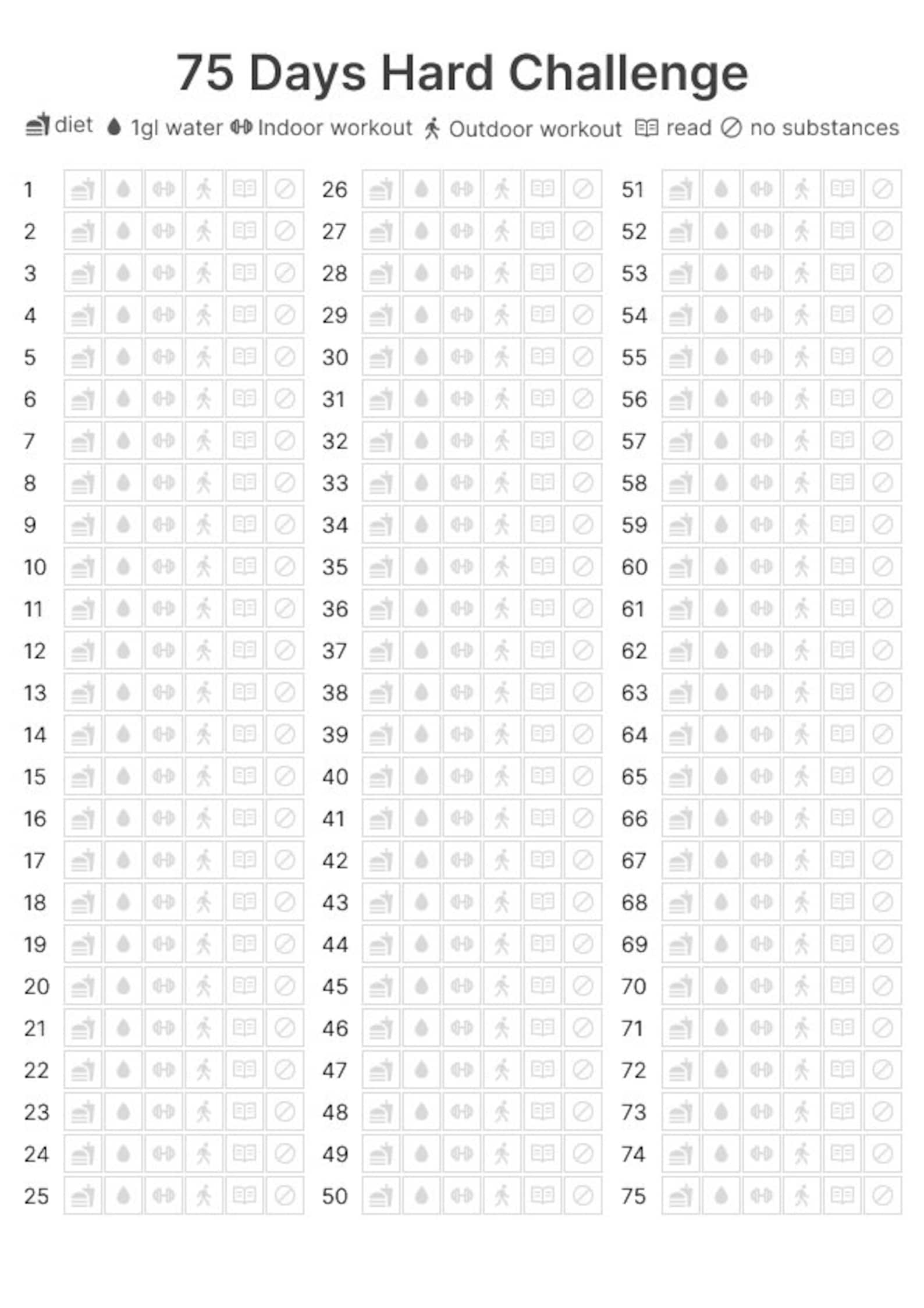
The 75 Day Hard Challenge is a strict 75-day mental toughness program created by entrepreneur Andy Frisella. Participants must complete five non-negotiable daily tasks: follow a structured diet with zero alcohol or cheat meals, complete two 45-minute workouts (one outdoors), drink one gallon of water, read ten pages of non-fiction, and take a progress photo. Failing any task resets the challenge to Day 1.
What Is the 75 Hard Challenge?
Developed in 2019 by entrepreneur, author, and podcaster Andy Frisella, 75 Hard is often mistaken for a standard physical fitness transformation plan. However, Frisella explicitly defines 75 Hard as a "transformational mental toughness program." The central premise is that building self-discipline, fortitude, grit, and self-worth requires absolute consistency without compromise, rationalization, or modification.
Unlike traditional fitness regimens that build in scheduled rest days, flexible meal plans, or deliberate periodization, 75 Hard demands strict adherence for 75 consecutive days. If a participant skips even a single daily requirement—whether forgetting to log a progress photo before sleep or missing the final half-cup of water—they must immediately reset to Day 1.
The program has gained widespread attention on social media platforms, drawing millions of participants worldwide. While many complete the program reporting significant improvements in self-discipline, physical conditioning, and habits, health experts emphasize that the challenge carries physical risks if approached without careful planning, proper nutrition, and medical awareness.
The 5 Core Daily Rules of 75 Hard
To successfully complete the 75 Hard challenge, a participant must perform five specific daily tasks every single calendar day for 75 consecutive days. There are no exemptions, modifications, or substitutions permitted under the official guidelines.
- DAILY 75 HARD REQUIREMENTS
- Follow a diet (No cheat meals, no alcohol)
- Two 45-minute workouts (One MUST be outdoors)
- Drink 1 gallon (3.78 liters) of water
- Read 10 pages of non-fiction (Physical book/e-reader)
- Take a daily progress photo
- Failing ANY task on ANY day requires:
- RESET TO DAY 1
1. Follow a Diet with Zero Cheat Meals and No Alcohol
Participants may choose any eating plan that aligns with their personal health goals—such as ketogenic, macro-tracking, Mediterranean, plant-based, or a standard calorie-deficit plan. However, once the chosen diet is defined, it must be followed with 100% compliance.
- No Cheat Meals: Any deliberate deviation from your specified dietary structure constitutes a failure.
- Zero Alcohol: Abstinence from all alcoholic beverages is mandatory for the entire 75 days, regardless of occasion or quantity.
2. Complete Two 45-Minute Workouts (One Must Be Outdoors)
The program requires two separate 45-minute physical exercise sessions per day.
- Separation: The workouts must be distinct sessions separated by several hours, not combined into a single 90-minute block.
- Outdoor Requirement: At least one workout must take place outside in the open air, regardless of weather conditions (rain, snow, heat, or cold).
- Intensity Flexibility: Workouts do not both need to be high-intensity weightlifting or cardio. Active recovery sessions, such as outdoor walking, yoga, mobility work, or light cycling, count as valid workouts provided they last at least 45 minutes.
3. Drink One Gallon of Plain Water Daily
Participants must consume one U.S. liquid gallon (approximately 3.78 liters or 128 fluid ounces) of plain water each day.
- Plain Water Only: Flavored waters, protein shakes, teas, juices, and zero-calorie sports drinks do not count toward this daily volume requirement.
- Pacing: Consuming this volume requires steady intake throughout the day to avoid discomfort or over-hydration risks late at night.
4. Read 10 Pages of Non-Fiction
Participants must read a minimum of 10 pages from a non-fiction book every day.
- Content Criteria: The book should focus on personal development, business, leadership, history, science, psychology, or skill acquisition.
- Format Restrictions: Physical books and standard e-readers (such as Kindle) qualify. Audiobooks do not count toward this requirement, as the rule emphasizes focused, active visual reading.
5. Take a Daily Progress Photo
A visual progress photograph must be taken every day to document physical and mental changes over time.
- Consistency: Photos should ideally be taken at the same time each day (e.g., immediately upon waking).
- Zero Tolerance: Forgetting to take the photo before going to sleep at night is one of the most common reasons participants fail and must reset to Day 1.
Program Comparison: 75 Hard vs. 75 Soft vs. Standard Training
Due to the intense nature of 75 Hard, community variations such as "75 Soft" have emerged for individuals seeking a more moderate lifestyle adaptation. The following table contrasts 75 Hard with 75 Soft and a traditional, periodized fitness regimen.
| Feature / Metric | 75 Hard (Official) | 75 Soft (Community Variant) | Standard Fitness & Health Regimen |
|---|---|---|---|
| Primary Goal | Mental toughness & zero-compromise discipline | Sustainable habit building & wellness | Progressive fitness, strength, or weight management |
| Daily Workouts | Two 45-min workouts daily (1 outdoors) | One 45-min workout daily (1 rest day per week) | 3–5 workouts per week with planned recovery days |
| Diet Rules | Any structured diet; 0 cheat meals, 0 alcohol | Eat clean, drink alcohol only on social occasions | Flexible macro/calorie targets; 80/20 balance rule |
| Water Intake | 1 Gallon (3.78 L) plain water daily | 3 Liters daily | Hydrate based on thirst, body mass, and activity level |
| Reading Requirement | 10 pages non-fiction daily (No audiobooks) | 10 pages of any book daily | Voluntary / optional self-study |
| Missed Task Penalty | Mandatory reset to Day 1 | Adjust and resume next day | Resume schedule without penalty |
| Flexibility Level | Zero | Moderate | High |
Health, Safety, and Medical Considerations
While 75 Hard can cultivate strong habits and mental resilience, executing an extreme daily routine for 75 consecutive days introduces potential health and safety risks. Consulting a physician or qualified healthcare provider before initiating the challenge is strongly recommended.
- SAFETY & RISK MITIGATION
- Hydration Risk: Prevent Hyponatremia (balance salts)
- Overtraining Risk: Include active recovery workouts
- Weather Exposure: Wear suitable gear outdoors
- Caloric Intake: Avoid extreme caloric deficits
Risk 1: Overuse Injuries and Overtraining
Performing 150 individual workouts over 75 consecutive days without taking full rest days places significant stress on joints, tendons, and muscles.
- Mitigation Strategy: Structure your exercise routine intelligently. Alternate high-intensity resistance training or running with low-impact sessions like walking, gentle yoga, swimming, or static stretching. Listening to body signaling is critical to prevent stress fractures, tendinitis, or systemic fatigue.
Risk 2: Water Intoxication and Hyponatremia
Drinking a full gallon of water daily is beneficial for many active individuals, but consuming high volumes too rapidly can dilate blood sodium levels—a potentially dangerous condition known as hyponatremia. The U.S. National Academies of Sciences, Engineering, and Medicine provides baseline guidelines for daily fluid intake, noting that individual needs vary based on climate, sweat rate, and physical activity.
- Mitigation Strategy: Spread fluid consumption evenly across waking hours (e.g., 8–12 ounces per hour). Ensure adequate sodium and electrolyte intake through balanced meals, particularly if engaging in intense outdoor sweating.
Risk 3: Extreme Weather Exposure
Completing an outdoor workout every day—regardless of heavy rain, severe cold, or intense heat—exposes participants to environmental hazards such as heat exhaustion, dehydration, or frostbite.
- Mitigation Strategy: Monitor local weather forecasts closely. Adjust workout times to avoid mid-day extreme heat during summer or bitter nighttime cold during winter. Dress in appropriate moisture-wicking layers or protective gear.
Risk 4: Restrictive Dieting and Caloric Deficits
Pairing intense double workouts with severely restricted caloric intake can trigger metabolic sluggishness, extreme lethargy, muscle loss, or unhealthy psychological relationships with food.
- Mitigation Strategy: Choose a diet plan focused on adequate energy availability. Ensure sufficient intake of complex carbohydrates, lean proteins, and essential fats to support continuous daily training.
Step-by-Step Execution Strategy
Succeeding in 75 Hard requires deliberate logistics and daily time management rather than reliance on fleeting motivation.
- DAILY ROUTINE TIMELINE
- 06:30 AM | Wake up, drink 16 oz water, take Daily Progress Photo
- 07:00 AM | Workout 1: 45-Minute Outdoor Power Walk or Jog
- 08:00 AM | Eat balanced breakfast according to chosen diet plan
- 12:30 PM | Read 10 pages of non-fiction during lunch break
- 05:30 PM | Workout 2: 45-Minute Indoor Weight Training / Mobility
- 07:00 PM | Dinner aligned with diet, continue steady water tracking
- 09:30 PM | Final check of water goal and daily task log before sleep
Step 1: Define Your Dietary Guidelines Before Day 1
Establish exact rules for your nutrition prior to starting. Clearly define what constitutes a "cheat meal" for your specific plan so there is no ambiguity on Day 25 or Day 50.
- Example: If tracking macronutrients, define clear upper and lower intake ranges rather than a single rigid number.
Step 2: Establish a Routine for Daily Tasks
Attach mandatory tasks to existing habits (habit stacking):
- Take your progress photo immediately after waking up and using the bathroom.
- Read your 10 pages during a fixed morning or lunch window rather than waiting until bedtime when fatigue sets in.
- Track your water intake in specific daily increments (e.g., finishing two 64-ounce water bottles by 7:00 PM).
Step 3: Schedule Workout Types Pragmatically
Plan your 14 weekly workouts in advance to avoid physical burnout.
- Monday/Wednesday/Friday: Morning outdoor walk (Workout 1) + Afternoon strength training (Workout 2).
- Tuesday/Thursday: Morning outdoor jog (Workout 1) + Evening indoor mobility/stretching (Workout 2).
- Saturday/Sunday: Outdoor cycling (Workout 1) + Indoor low-intensity yoga (Workout 2).
Common Pitfalls That Force a Day 1 Reset
Understanding why participants most frequently fail helps mitigate common operational mistakes.
COMMON RESET TRIGGER POINTS
| Pitfall | Prevention Action |
|---|---|
| Forgetting Progress Photo | Take photo immediately upon waking up |
| Delayed Water Intake | Consume 50% of water target by noon |
| Reading Late at Night | Complete 10 pages before 5:00 PM |
| Back-to-Back Workouts | Allow at least 3-4 hours between sessions |
- Forgetting the Daily Photo: Falling asleep without taking a progress photo is the single most reported cause of failure. Setting a recurring daily phone alarm or placing a reminder note on your bathroom mirror prevents this mistake.
- Delaying Hydration Until Late Evening: Realizing at 9:00 PM that you still need to drink half a gallon of water leads to disrupted sleep, discomfort, and potential over-hydration. Drink continuously from morning onward.
- Reading While Fatigued: Waiting to read your 10 pages in bed late at night frequently results in falling asleep mid-page or re-reading the same paragraph without absorbing content.
- Lacking Separation Between Workouts: Attempting to count an 80-minute workout or taking a 10-minute break in a gym before resuming exercise violates the two-distinct-workout rule. Leave a clear gap of several hours between sessions.
Frequently Asked Questions
Can I modify the 75 Hard rules if I am injured or sick?
No. The official program rules created by Andy Frisella state that there are no modifications or compromises for illness, injury, travel, or busy schedules. If you cannot complete a rule safely due to illness or physical injury, you must stop or pause the program, prioritizing your medical health over challenge completion.
Do audiobooks or digital ebooks count toward the reading requirement?
Digital ebooks read on smartphones, tablets, or dedicated e-readers (such as Kindle) count toward the 10-page daily requirement. However, audiobooks do not count. The program emphasizes visual reading to foster sustained mental focus and concentration.
What happens if I forget to take a progress photo until midnight?
As long as you take the photo before you go to sleep for that calendar day, it satisfies the requirement. However, if you wake up the following morning and realize you forgot the photo from the previous day, you have failed the challenge and must reset to Day 1.
Can both 45-minute workouts be done indoors during extreme weather?
No. Under official 75 Hard rules, one of the two daily 45-minute workouts must take place outdoors, regardless of environmental conditions such as rain, extreme cold, or heat. Participants are expected to dress appropriately for safety while fulfilling the outdoor requirement.
Is 75 Hard suitable for beginners?
Because 75 Hard demands two daily workouts and zero rest days for 75 consecutive days, absolute beginners should proceed with caution. Beginners can adapt by making low-intensity exercise (such as brisk walking and light stretching) the core of their daily routine, or they may consider starting with a more moderate protocol like 75 Soft.
Next Steps and Practical Recommendations
If you decide to undertake the 75 Hard challenge, preparation before Day 1 is critical to safely reaching Day 75:
- Obtain Medical Clearance: Consult a primary care physician to review your physical health, planned exercise intensity, and proposed dietary guidelines.
- Select Your Books in Advance: Choose 3 to 4 non-fiction books focused on personal growth, skill building, or business so you never lose momentum between titles.
- Procure Equipment and Gear: Invest in durable outdoor attire (waterproof layers, reflective gear, thermal clothing, or sun protection) to handle weather variations over the 75-day period.
- Set Up Daily Tracking: Utilize a dedicated checklist app, physical journal, or the official 75 Hard mobile application to log your photo, reading, water, and workouts daily before sleeping.