A death clock is a digital tool or statistical model that estimates an individual’s remaining lifespan based on demographic data, lifestyle choices, and health history. By aggregating actuarial data and personal variables, these calculators provide a projected date of passing, often serving as a motivational catalyst for health improvements or financial planning.
The concept of a "death clock" has transitioned from a macabre internet novelty into a sophisticated field of personalized health analytics. In 2026, the integration of wearable technology and artificial intelligence has transformed these tools from simple web scripts into predictive engines that help individuals understand their "healthspan"—the period of life spent in good health—rather than just their total years. Understanding how these tools function, the data they require, and the science behind their predictions is essential for anyone looking to optimize their long-term well-being.
The Evolution of Lifespan Prediction Tools
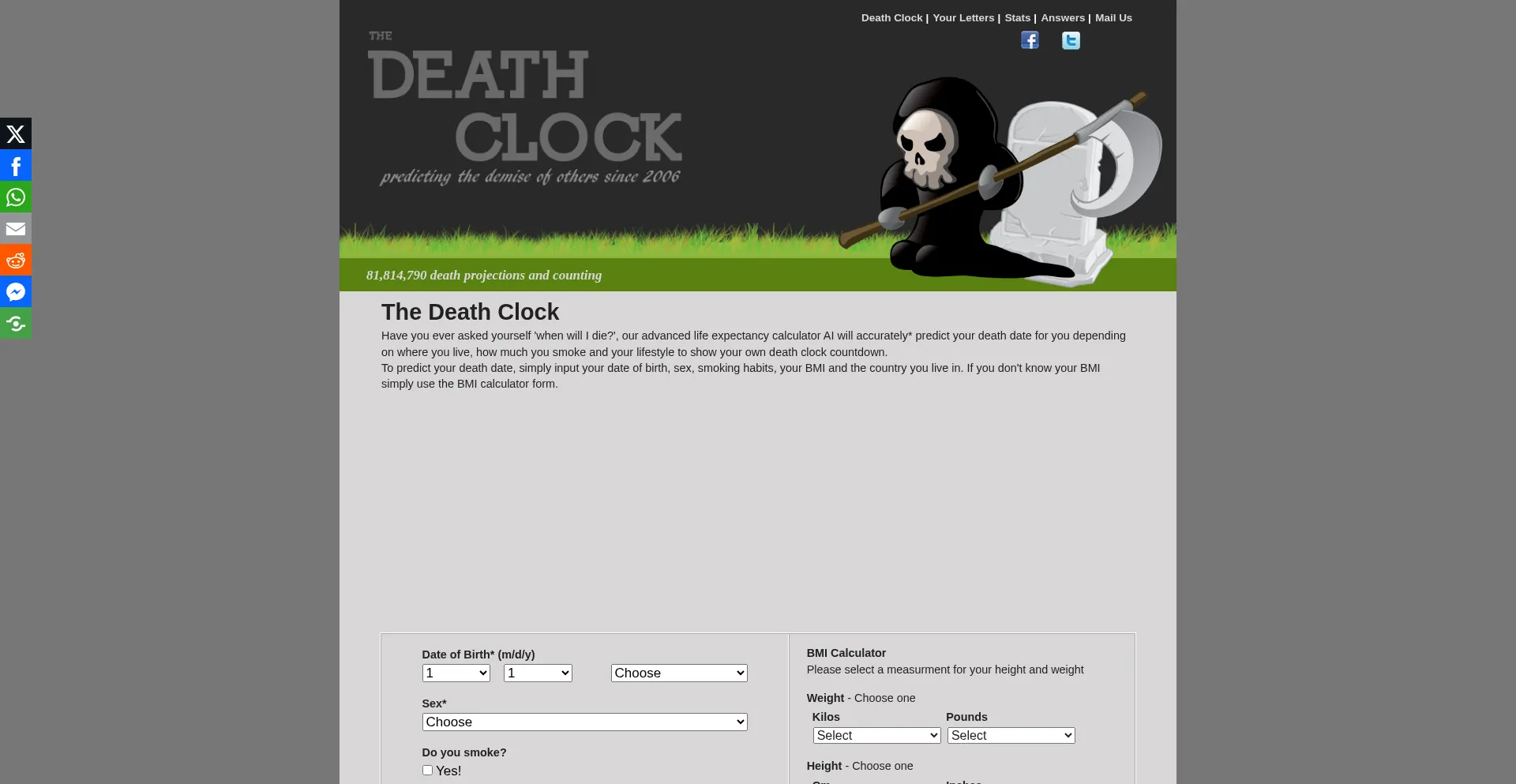
The earliest iterations of the death clock appeared in the late 1990s and early 2000s. These were rudimentary web forms that asked for a user's birth date, sex, and smoking status. They relied heavily on basic actuarial tables provided by government agencies, such as the Social Security Administration (SSA) in the United States. While entertaining, they lacked the nuance required for personal health management.
By 2026, the landscape has shifted. Modern longevity estimators now utilize machine learning algorithms trained on massive longitudinal datasets. They no longer look at the user as a static data point but as a dynamic system. These "Death Clock 2.0" platforms can often sync with health apps to track real-time metrics like resting heart rate, sleep quality, and VO2 max. This evolution reflects a broader trend in preventative medicine: the move from reactive treatment to proactive risk mitigation.
From Actuarial Tables to Personalized AI
Traditional calculators used "population averages." If the average male in a specific country lived to 78, the clock would start there and subtract years for negative habits like smoking. However, this ignored the "healthy smoker" paradox or the "unhealthy athlete" scenario. Today’s advanced models account for genetic predispositions and socioeconomic factors, providing a much narrower margin of error, though they remain estimates rather than certainties.
How a Death Clock Calculates Your Date
The underlying mechanism of any reputable longevity tool is a combination of historical mortality data and individual risk factors. To understand your result, it is necessary to break down the primary variables these systems analyze.
Demographic Foundation
The calculation begins with your age and biological sex. Statistically, women tend to outlive men globally, a fact attributed to both biological advantages (such as the protective effects of estrogen) and behavioral differences. The tool also considers your current age because the longer you live, the higher your projected "final" age becomes. This is a concept known as "survivorship bias" in statistics; a 90-year-old has already survived the risks that claim younger people, so their projected death date is statistically later than it was when they were 20.
Lifestyle Inputs
This is where the user has the most control over the clock’s movement. Key variables include:
- Tobacco and Substance Use: Smoking remains the single largest "accelerant" for the death clock, often stripping a decade or more from the prediction.
- Body Mass Index (BMI) and Body Composition: While BMI is a blunt instrument, extreme ends of the scale correlate strongly with cardiovascular and metabolic risks.
- Physical Activity: Regular aerobic and resistance training are weighted heavily as "decelerants" of the aging process.
- Dietary Patterns: High consumption of processed foods versus a Mediterranean-style diet can shift the clock by several years.
Environmental and Psychosocial Factors
Modern tools in 2026 also weigh "invisible" factors. This includes your zip code (which correlates with air quality and access to healthcare) and your social connectivity. Loneliness has been scientifically linked to a mortality risk comparable to smoking 15 cigarettes a day, a finding that high-end death clocks now integrate into their algorithms.
Biological Age vs. Chronological Age
One of the most significant developments in longevity science is the distinction between how many years you have lived (chronological age) and how old your body "functions" (biological age). Many death clocks now offer a "Bio-Age" score alongside the projected death date.
Epigenetic Clocks
The gold standard for determining biological age involves "epigenetic clocks" like the Horvath Clock. These tests measure DNA methylation—chemical changes to your DNA that occur as you age. While a standard online death clock cannot measure your DNA, many high-tier services now allow users to upload blood test results or epigenetic data to refine their predicted lifespan.
Functional Biomarkers
If you do not have access to genetic testing, death clocks use functional markers as proxies. These include:
- Grip Strength: A surprisingly accurate predictor of all-cause mortality in older adults.
- Walking Speed: Correlates with neurological and cardiovascular health.
- Heart Rate Variability (HRV): A measure of autonomic nervous system balance and stress resilience.
Comparing Different Longevity Assessment Tools
Not all "death clocks" are created equal. They range from simple psychological motivators to complex financial planning tools used by insurance companies.
| Tool Type | Primary Data Source | Best Use Case | Accuracy Level |
|---|---|---|---|
| Novelty Web Clock | Basic SSA Actuarial Tables | Curiosity/Motivation | Low |
| Insurance Underwriting | Medical Records & Lab Work | Life Insurance Pricing | High (Statistical) |
| Health App Integration | Wearable Data (HRV, Sleep) | Daily Lifestyle Adjustments | Moderate/Dynamic |
| Epigenetic Test | DNA Methylation Markers | Scientific Biological Tracking | Very High |
| Socioeconomic Models | Zip Code & Education Data | Public Health Research | High (Population Level) |
The Psychological Impact of Seeing the Clock
The primary goal of a death clock is rarely to provide a literal, unchangeable date. Instead, it serves as a "memento mori"—a reminder of mortality designed to spur action. This can have two distinct effects on the user.
Positive Behavior Change
For many, seeing a "death date" in their 60s due to sedentary habits serves as a wake-up call. Because the clock is dynamic, users can often see the date "move" in real-time as they input better data (e.g., "If I quit smoking today, my date moves from 2045 to 2055"). This immediate feedback loop is a powerful psychological tool for habit formation.
Mortality Salience and Anxiety
Conversely, for some individuals, these tools can trigger "death anxiety." It is important to approach these calculators with the understanding that they are based on probability, not prophecy. No algorithm can account for accidental death, emerging pandemics, or sudden technological breakthroughs in medicine.
Using the Death Clock for Financial and Estate Planning
Beyond health, the death clock serves a pragmatic purpose in wealth management. As we move through 2026, financial advisors increasingly use longevity estimators to help clients determine:
- Retirement Drawdown: Ensuring that your savings last as long as you do.
- Long-Term Care Insurance: Determining when you are most likely to need assisted living.
- Life Insurance Needs: Calculating the term length required to protect dependents.
If a death clock suggests a high probability of living into the late 90s, the "traditional" retirement model of stopping work at 65 may need to be adjusted to prevent outliving assets.
Common Misconceptions About Lifespan Calculators
To use these tools effectively, one must look past the sensationalism often found in media coverage.
"The Date is Set in Stone"
This is the most common myth. A death clock provides a median outcome based on thousands of people "like you." It does not account for individual outliers. Your lifestyle choices today can and will change the trajectory of the calculation.
"Genetic Destiny is Everything"
While genetics play a role, particularly in reaching extreme old age (95+), the majority of life expectancy is determined by lifestyle and environment. The phrase "Genetics loads the gun, but lifestyle pulls the trigger" is a guiding principle in longevity science.
"Only Old People Need to Check"
In reality, the death clock is most useful for those in their 20s and 30s. This is the period when the "compounding interest" of healthy habits is at its peak. Small changes made early in life result in the largest shifts in the predicted date.
Future Trends: The Death Clock in the Age of AI
As we look toward the remainder of 2026 and beyond, the death clock will likely become an "always-on" feature of personal health ecosystems. We are seeing the rise of "digital twins"—virtual models of your body that simulate how different interventions (like a new medication or a change in diet) will impact your projected lifespan.
Integration with the World Health Organization's (WHO) data on environmental risks and the Centers for Disease Control and Prevention's (CDC) latest mortality statistics ensures that these models are updated with the most current scientific findings.
FAQs
Are online death clocks accurate?
Online death clocks are statistically accurate on a population level but lack individual precision. They use actuarial data from organizations like the Social Security Administration to provide an estimate based on averages. While they can identify trends and risks, they cannot predict specific medical events or accidents.
Can I actually change my predicted death date?
Yes. Most sophisticated death clocks allow for "what-if" scenarios. By changing inputs such as exercise frequency, diet, and smoking status, you can see how specific lifestyle modifications statistically extend your life expectancy. This makes the tool an interactive map for health improvement.
What is the difference between lifespan and healthspan?
Lifespan is the total number of years you live. Healthspan is the number of years you live in a state of good health, free from chronic disease or functional disability. Modern death clocks are increasingly focusing on "Healthspan Clocks" to help users maximize their quality of life, not just the quantity of years.
Do insurance companies use death clocks?
Insurance companies use highly advanced versions of these tools called actuarial models. These models are much more detailed than consumer death clocks and include clinical data, prescription history, and sometimes even driving records to determine life insurance premiums and coverage eligibility.
What is the 'Gompertz Law' in relation to death clocks?
The Gompertz-Makeham law of mortality states that a person's risk of death increases exponentially with age after reaching adulthood. Death clocks use this mathematical formula as the "base rate" for their predictions, which is then adjusted by the user's specific health data.
Final Recommendation
When using a death clock, treat it as a diagnostic starting point rather than a final verdict. Use the information to identify your highest risk factors—whether that be a lack of physical activity, poor sleep, or high stress—and address them systematically. For the most accurate assessment, combine a lifestyle-based calculator with regular medical check-ups and, if possible, biological age testing through a healthcare provider. The goal is not to obsess over the end date, but to ensure that the years remaining are lived with maximum vitality.