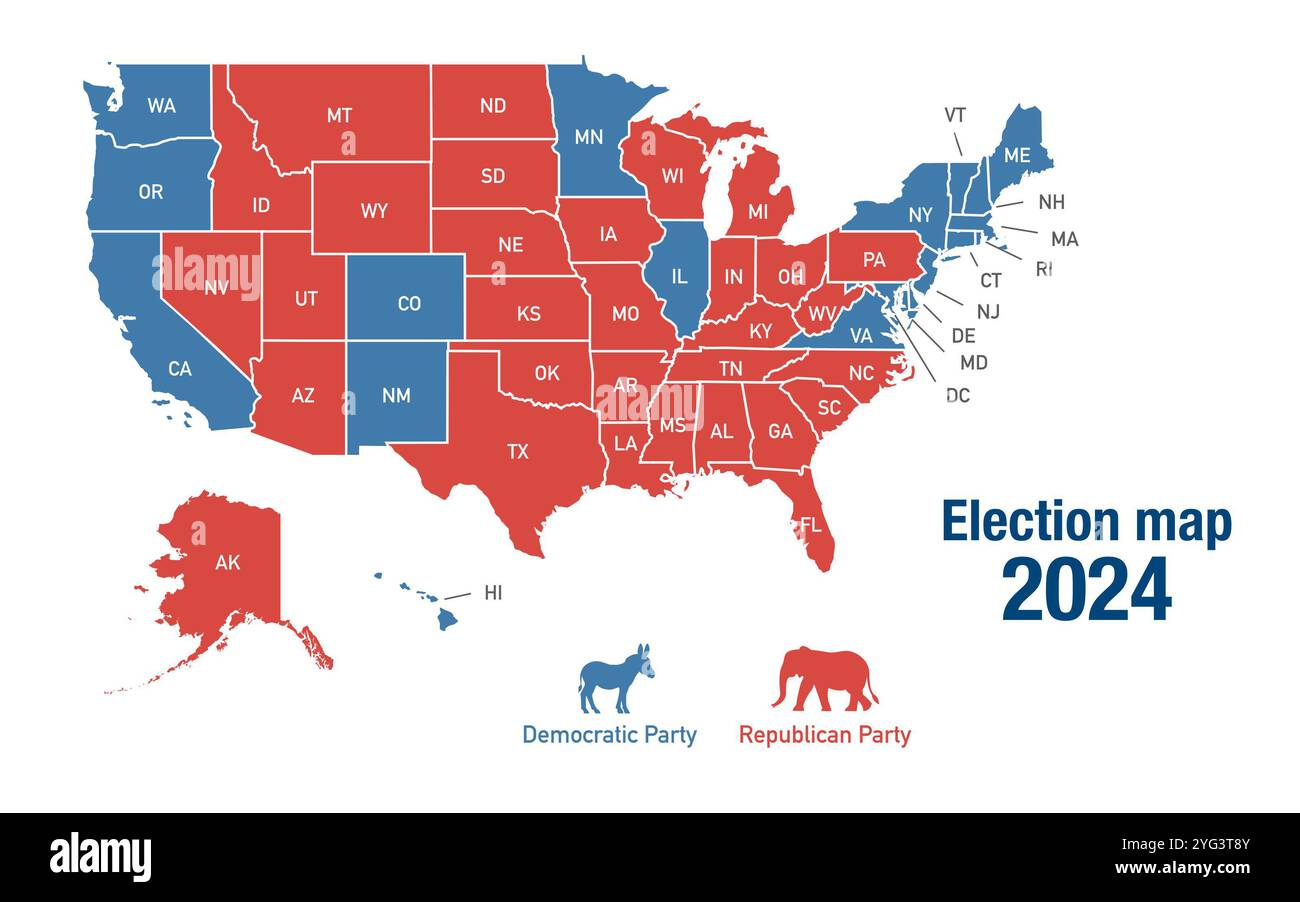
The 2024 United States presidential election concluded on November 5, 2024, resulting in former President Donald Trump securing a second, non-consecutive presidential term alongside Vice President-elect JD Vance. Securing 312 electoral votes and winning the national popular vote, the Republican ticket defeated Democratic candidates Vice President Kamala Harris and Minnesota Governor Tim Walz.
While 2024 featured significant national elections across the globe—including major parliamentary and general elections in the United Kingdom, India, Mexico, and the European Union—the U.S. national election served as a primary focus for global governance, economic policy, and international trade dynamics. Understanding the complete outcome requires examining the presidential campaign dynamics, the shifting balance of power in the U.S. Congress, state-level voting patterns, and the formal constitutional processes that finalized the results.
Overview of the 2024 U.S. National Election Cycle
The 2024 U.S. election cycle stood out as one of the most unusual political events in modern American history due to unprecedented structural changes in major-party tickets, substantial legal proceedings, and shifting voter demographics across traditional political geographies.
The primary season began in early 2024, with incumbent President Joe Biden securing the necessary delegates for the Democratic nomination, while Donald Trump won a series of rapid primary victories to solidify his position as the Republican nominee. However, following a debate performance in June 2024 and subsequent discussions within his party, President Biden announced on July 21, 2024, that he would withdraw from the presidential race. He endorsed Vice President Kamala Harris, who rapidly consolidated support among delegates and was officially nominated at the Democratic National Convention in August 2024.
2024 U.S. Presidential Election Timeline
- Jan–June 2024: Primary Elections & Party Delegate Collection
- July 21, 2024: President Joe Biden Withdraws from Presidential Race
- August 2024: Kamala Harris Formally Nominated at DNC
- Nov 5, 2024: Election Day Held Across All 50 States & D.C.
- Dec 17, 2024: Electors Cast Official Electoral Votes in State Capitals
- Jan 6, 2025: Joint Session of Congress Formally Counts Electoral Votes
- Jan 20, 2025: Presidential Inauguration Ceremonies Held in D.C.
The general election campaign centered on critical domestic and foreign policy challenges. Economic concerns—specifically post-pandemic inflation, housing affordability, and interest rates—remained top priorities for voters nationwide. Additional major themes included border security, national immigration law, reproductive rights, federal regulation, and foreign involvement in regional conflicts.
Presidential Race Breakdowns and Electoral College Results
To win the U.S. presidency, a candidate must obtain a minimum of 270 out of the total 538 votes in the U.S. National Archives Electoral College. In 2024, the contest hinged on seven key battleground states: Pennsylvania, Michigan, Wisconsin, Georgia, North Carolina, Arizona, and Nevada.
Donald Trump secured victory by winning all seven of these key battleground states, reversing electoral losses from 2020 in Pennsylvania, Michigan, Wisconsin, Georgia, and Arizona, while retaining North Carolina and gaining Nevada. This geographic sweep pushed the Republican total to 312 electoral votes, compared to 226 electoral votes for Democratic candidate Kamala Harris.
2024 Electoral Vote Tally
- Donald Trump (Republican): 312
- Kamala Harris (Democrat): 226
- Needed to Win: 270
Beyond the Electoral College, the 2024 election marked the first time since 2004 that a Republican presidential nominee won the national popular vote. Shifts occurred across diverse demographic groups and geographic regions. Data from county-level tallies indicated significant Republican gains among rural voters, suburban working-class communities, and notable increases in support among Hispanic and male voters across major metropolitan areas.
Third-party and independent candidates also impacted the race, though none earned electoral votes. Independent candidate Robert F. Kennedy Jr. initially mounted a notable campaign before suspending his active efforts in August 2024 and endorsing Donald Trump. Libertarian candidate Chase Oliver and Green Party nominee Jill Stein appeared on numerous state ballots, drawing varying percentages of the minor-party vote.
Comprehensive 2024 Battleground State Results Summary
The table below illustrates the electoral contribution and outcome across the seven primary battleground states that decided the 2024 presidential election. Official vote statistics and historic tallies are published by state election authorities and collated by the Federal Election Commission Official Election Results.
| State | Electoral Votes | 2024 Winning Candidate | 2024 Winning Margin (%) | 2020 Previous Winner | Primary Factor Influencing Outcome |
|---|---|---|---|---|---|
| Pennsylvania | 19 | Donald Trump | ~1.7% | Joe Biden | Higher rural turnout; shifts in industrial hubs |
| Georgia | 16 | Donald Trump | ~2.2% | Joe Biden | Increased suburban margin recovery & rural turnout |
| North Carolina | 16 | Donald Trump | ~3.3% | Donald Trump | Consistent suburban resistance; high rural engagement |
| Michigan | 15 | Donald Trump | ~1.4% | Joe Biden | Economic messaging; shifts in automotive & suburban regions |
| Arizona | 11 | Donald Trump | ~5.5% | Joe Biden | Heavy focus on border security and economic costs |
| Wisconsin | 10 | Donald Trump | ~0.9% | Joe Biden | High turnout in non-metropolitan counties |
| Nevada | 6 | Donald Trump | ~3.1% | Joe Biden | Shifts among service sector and Hispanic working-class voters |
Congressional Elections and Government Balance of Power
In addition to the presidential contest, voters determined the composition of the 119th United States Congress. All 435 seats in the U.S. House of Representatives and 34 seats in the U.S. Senate were on the ballot. Official legislative proceedings and seat distributions are tracked by Congress.gov Legislative Information.
The U.S. Senate
Republicans regained control of the U.S. Senate in 2024, entering the 119th Congress with a majority. The party flipped key seats in West Virginia, Ohio, and Montana, where Republican challengers defeated Democratic incumbents or captured open seats.
- West Virginia: Governor Jim Justice secured the seat vacated by retiring Independent Senator Joe Manchin.
- Ohio: Bernie Moreno defeated three-term Democratic incumbent Sherrod Brown.
- Montana: Tim Sheehy defeated three-term Democratic incumbent Jon Tester.
These pick-ups provided Republicans with a operational Senate majority, enabling them to control committee leadership, determine legislative schedules, and streamline the confirmation process for judicial appointees and executive cabinet nominees.
The U.S. House of Representatives
Control of the U.S. House of Representatives remained extremely tight throughout the vote counting period following Election Day. Republicans ultimately secured the 218 seats required for a majority, maintaining unified party control across both chambers of Congress and the executive branch.
Unified government control provides the governing party with direct mechanisms to pass budget reconciliation measures, enact tax reform policies, modify federal regulatory oversight, and align legislative priorities with executive orders.
Key Issues Driving Voter Decisions in 2024
Public opinion research and exit polls showed that voters evaluated candidates based on several pressing national issues:
- Economic Stabilization and Inflation: Elevated consumer prices, grocery costs, mortgage interest rates, and energy expenses over the preceding four years made economic performance the paramount concern for a majority of voters.
- Immigration and Border Enforcement: The management of the U.S. southern border, processing of asylum claims, and domestic enforcement mechanisms emerged as central points of debate across suburban and border communities alike.
- Reproductive Rights and Judicial Nominations: Following the Supreme Court’s 2022 decision overturning Roe v. Wade, ballot initiatives regarding abortion access appeared in ten states in 2024. Voters in states such as Florida, Ohio, and Arizona evaluated both state-level constitutional amendments and federal judicial philosophy.
- Foreign Policy and National Security: Ongoing conflicts in Eastern Europe and the Middle East raised questions regarding foreign assistance funding, trade tariffs, military deterrence, and international alliances.
Electoral Process, Voting Mechanics, and Security Verification
The 2024 election highlighted the complex operational frameworks managed by local and state government election administrators. Under the U.S. Constitution, individual states manage vote collection, ballot counting, and result certifications. Voter registration trends and administrative structures are tracked nationally by the U.S. Census Bureau Voting Statistics.
Voting Methods Utilized
State laws dictate the availability of early voting and mail-in options. In 2024, millions of voters cast ballots before Election Day:
- In-Person Early Voting: Allowed voters to cast ballots at designated polling sites prior to November 5.
- Mail-In / Absentee Voting: Utilized heavily across several states, requiring secure drop-boxes or postal delivery with signature verification procedures.
- Election Day In-Person Voting: Traditional voting at assigned precinct polling places.
Certification Timeline and Statutory Framework
Following the close of polls, local election boards conducted post-election audits, verified signatures, processed provisional ballots, and completed canvassing routines.
- State Canvassing Deadlines: Between mid-November and early December 2024, state secretaries of state formally certified the final vote tallies.
- Meeting of Electors (December 17, 2024): Electors met in their respective state capitals to cast official electoral votes for president and vice president.
- Congressional Certification (January 6, 2025): A joint session of Congress convened to formally count and certify the electoral votes under the modernized provisions of the Electoral Count Reform Act of 2022.
- Inauguration Day (January 20, 2025): The President and Vice President officially took the oath of office outside the U.S. Capitol building.
Accessing Official Public Records and Election Data
Citizens, historians, and policy researchers looking to review election data should consult verified official archives rather than unverified third-party platforms.
- Federal Election Commission (FEC): Manages campaign finance reporting, candidate registration filings, financial disclosure reports, and official combined federal election results.
- National Archives and Records Administration (NARA): Maintains official Certificates of Ascertainment and Certificates of Vote submitted by each state's governor and electoral college representatives.
- State Department/Secretary of State Portals: Each state maintains a dedicated division of elections publishing precinct-level breakdowns, turnout percentages, and recount logs.
Frequently Asked Questions
How did the Electoral College vote breakdown in the 2024 presidential election?
Donald Trump won 312 electoral votes, while Kamala Harris received 226 electoral votes. Trump achieved this majority by sweeping all seven key battleground states: Pennsylvania, Georgia, North Carolina, Michigan, Arizona, Wisconsin, and Nevada.
How were candidates selected for the major political parties in 2024?
Donald Trump secured the Republican nomination through standard state primary elections and caucuses. Joe Biden initially won the Democratic primaries; however, after he withdrew from the race in July 2024, delegates at the Democratic National Convention officially nominated Vice President Kamala Harris as the party's standard-bearer.
Which party won control of the U.S. Congress in the 2024 elections?
The Republican Party achieved a unified majority in Congress. They flipped key seats in West Virginia, Ohio, and Montana to secure control of the U.S. Senate, while retaining a majority in the U.S. House of Representatives.
How do state election officials verify and certify official vote tallies?
State election officials conduct post-election canvasses, verify signature matches on mail-in envelopes, audit voting equipment, and count provisional ballots. Once local election boards confirm accuracy, state leaders (such as the Secretary of State and Governor) sign official Certificates of Ascertainment.
What was the legal significance of the Electoral Count Reform Act during the 2024 tally?
Enacted in late 2022, the Electoral Count Reform Act updated the 1887 law governing the congressional vote count. It clarified the role of the Vice President as purely ministerial, raised the thresholds required for members of Congress to object to state electoral slates, and designated governors as the sole authority for submitting official state certifications.
Key Takeaways for Civic Engagement and Verification
Navigating historical electoral outcomes requires relying on official records and documented statutory procedures. For verified documentation regarding campaign finances, legislative votes, and certified electoral tallies, consult state election portals, the Federal Election Commission, or the U.S. National Archives. Staying informed through official constitutional channels ensures accurate understanding of government transitions and civic processes.