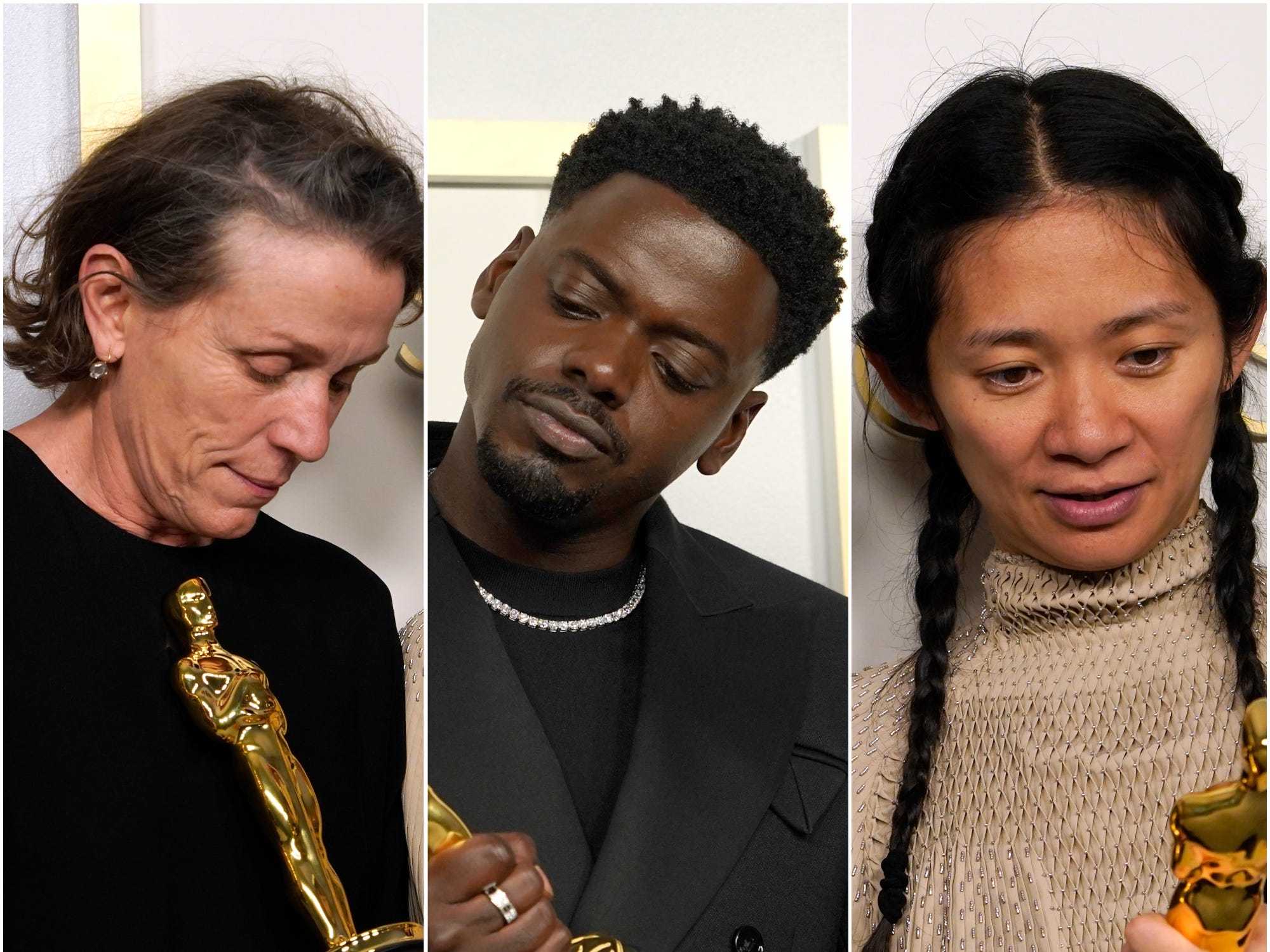
The 93rd Academy Awards, held on April 25, 2021, represented a historic shift in cinematic celebration, defined by the constraints of the global pandemic and a daring departure from traditional ceremony formats. Headlined by the sweeping success of Nomadland and Chloé Zhao’s historic directorial win, the night was characterized by its intimate setting at Los Angeles’ Union Station and a controversial reshuffling of the final award categories.
The 2021 Oscars arrived at a time when the film industry was grappling with shuttered theaters and delayed releases. Despite these hurdles, the Academy of Motion Picture Arts and Sciences delivered a ceremony that prioritized storytelling and the personal histories of the nominees. Produced by Steven Soderbergh, Jesse Collins, and Stacey Sher, the telecast felt less like a variety show and more like a high-end cinematic production, shot at 24 frames per second to give it a "movie-like" aesthetic.
A New Venue and a Distinctive Visual Identity
The decision to move the primary ceremony from the massive Dolby Theatre to the historic Union Station in downtown Los Angeles was the most significant logistical change. This move allowed for a "socially distanced" supper-club atmosphere. Nominees and their guests sat at small, lamp-lit tables, creating an environment that felt more exclusive and conversational than the typical theater seating.
The visual highlights of the night were captured through tight, intimate camera work. Without a traditional host, the show relied on presenters to tell longer, more personal stories about the nominees. This approach replaced the fast-paced comedy bits of previous years with a slower, more reverent tone. For viewers watching in 2026, this ceremony remains a fascinating time capsule of how the industry adapted to extreme external pressures while attempting to maintain its "prestige" branding.
Major Category Winners: A Night of Firsts and Upsets
The 2021 winners list was a mixture of expected triumphs and one of the most shocking upsets in Oscar history. The evening was dominated by Nomadland, which secured three of the most prestigious awards of the night.
Best Picture and Best Director: The Reign of Nomadland
Nomadland, a poetic exploration of life on the fringes of American society, was the night's biggest winner. The film followed Fern, played by Frances McDormand, as she traveled through the American West in a van. Chloé Zhao made history by becoming the first woman of color and the second woman ever to win the Academy Award for Best Director. Her win was a milestone for the Academy, signaling a move toward recognizing a broader spectrum of directorial voices.
Best Actress: Frances McDormand’s Third Win
Frances McDormand’s portrayal of Fern earned her the Oscar for Best Actress. This win placed her in an elite group of performers, marking her third Academy Award in the leading actress category (following Fargo and Three Billboards Outside Ebbing, Missouri). McDormand, known for her brief and unconventional acceptance speeches, used her time to advocate for the return of the theatrical experience, literally howling like a wolf in tribute to the film’s sound mixer, Michael Wolf Snyder, who had passed away earlier that year.
The Best Actor Upset: Anthony Hopkins and the Late Chadwick Boseman
The most talked-about moment of the night occurred at the very end of the telecast. In a departure from decades of tradition, the Academy moved the Best Picture announcement up, choosing to end the night with Best Actress and Best Actor. Most observers believed this was done to conclude the show with a posthumous tribute to Chadwick Boseman, who was widely expected to win for Ma Rainey’s Black Bottom.
However, the Oscar went to Sir Anthony Hopkins for his devastating portrayal of a man with dementia in The Father. Because Hopkins was not present at the ceremony and the producers had no one to accept on his behalf, the show ended abruptly with presenter Joaquin Phoenix standing awkwardly on stage. The following morning, Hopkins posted a gracious video from his home in Wales, acknowledging Boseman and expressing his surprise at the win.
Historical Milestones and Supporting Performances
Beyond the top categories, the 93rd Academy Awards celebrated several groundbreaking achievements in the supporting categories.
- Yuh-Jung Youn (Best Supporting Actress): For her role in Minari, Yuh-Jung Youn became the first Korean actor to win an Oscar. Her acceptance speech was a highlight of the night; she joked about meeting Brad Pitt (who presented her with the award) and critiqued the way people mispronounce her name. Her win was a significant moment for international cinema, continuing the momentum started by Parasite the year prior.
- Daniel Kaluuya (Best Supporting Actor): Kaluuya won for his powerful portrayal of Black Panther Chairman Fred Hampton in Judas and the Black Messiah. His speech was high-energy and memorable, particularly for a humorous comment regarding his parents’ "romantic" history that left his mother and sister in the audience looking both confused and amused.
- Ann Roth (Best Costume Design): At 89 years old, Roth became the oldest woman to win an Oscar, taking home the prize for her vibrant and historically accurate work on Ma Rainey’s Black Bottom.
Complete List of 2021 Oscar Winners
The following table provides a comprehensive overview of the winners across all categories during the 93rd Academy Awards.
| Category | Winner | Film |
|---|---|---|
| Best Picture | Mollye Asher, Dan Janvey, Frances McDormand, Peter Spears, Chloé Zhao | Nomadland |
| Directing | Chloé Zhao | Nomadland |
| Actor in a Leading Role | Anthony Hopkins | The Father |
| Actress in a Leading Role | Frances McDormand | Nomadland |
| Actor in a Supporting Role | Daniel Kaluuya | Judas and the Black Messiah |
| Actress in a Supporting Role | Yuh-Jung Youn | Minari |
| Original Screenplay | Emerald Fennell | Promising Young Woman |
| Adapted Screenplay | Christopher Hampton and Florian Zeller | The Father |
| Animated Feature Film | Pete Docter and Dana Murray | Soul |
| International Feature Film | Denmark | Another Round |
| Documentary Feature | Pippa Ehrlich, James Reed, and Craig Foster | My Octopus Teacher |
| Cinematography | Erik Messerschmidt | Mank |
| Film Editing | Mikkel E.G. Nielsen | Sound of Metal |
| Original Score | Trent Reznor, Atticus Ross, and Jon Batiste | Soul |
| Original Song | "Fight for You" (H.E.R., Dernst Emile II, Tiara Thomas) | Judas and the Black Messiah |
| Production Design | Donald Graham Burt and Jan Pascale | Mank |
| Costume Design | Ann Roth | Ma Rainey's Black Bottom |
| Makeup and Hairstyling | Sergio Lopez-Rivera, Mia Neal, and Jamika Wilson | Ma Rainey's Black Bottom |
| Sound | Nicolas Becker, Jaime Baksht, Michelle Couttolenc, Carlos Cortés, and Phillip Bladh | Sound of Metal |
| Visual Effects | Andrew Jackson, David Lee, Andrew Lockley, and Scott Fisher | Tenet |
| Animated Short Film | Will McCormack and Michael Govier | If Anything Happens I Love You |
| Live Action Short Film | Travon Free and Martin Desmond Roe | Two Distant Strangers |
| Documentary Short Subject | Anthony Giacchino and Alice Doyard | Colette |
The "Full Show" Atmosphere: A Cinematic Recap
The 2021 telecast attempted to fix what many saw as the "stale" nature of awards shows. There was no orchestra in the room; instead, Questlove served as the resident DJ, providing a curated soundtrack that bridged the gaps between segments.
The Red Carpet
The red carpet was scaled back significantly. Only a small number of media outlets were permitted, and the stars arrived in shifts. Despite the limitations, the fashion was notable for its boldness. Carey Mulligan appeared in a massive gold Valentino gown, and Zendaya wore a vibrant yellow Pierpaolo Piccioli creation that became one of the most photographed looks of the decade.
The Speeches
Because the producers removed the "wrap-up" music that usually cuts off winners, the speeches in 2021 were notably longer. This allowed for more emotional depth. Thomas Vinterberg, director of Another Round, delivered a gut-wrenching speech about the loss of his daughter during the production of the film, a moment that remains one of the most moving in Oscar history.
The Trivia Segment
One of the lighter moments involved a musical trivia game hosted by Lil Rel Howery and Questlove. Nominees had to guess if a song was an Oscar winner, a nominee, or neither. This culminated in Glenn Close demonstrating her knowledge of "Da Butt" and performing an impromptu dance that went viral instantly.
Craft and Technical Achievement Highlights
While the "Big Five" awards usually take the spotlight, the 2021 Oscars were a banner year for technical innovation.
- Sound of Metal: This film’s win for Best Sound was a technical necessity. The film’s sound design was critical to the narrative, as it simulated the experience of a drummer losing his hearing. The win highlighted how sound can be used as a primary storytelling device rather than just a background element.
- Mank: Despite being the most nominated film of the night (10 nominations), David Fincher’s Mank primarily succeeded in the craft categories, winning for Cinematography and Production Design. Its recreation of 1930s Hollywood was a masterclass in digital black-and-white photography.
- Tenet: Christopher Nolan’s Tenet took home the Visual Effects award. In an era dominated by CGI, Tenet was recognized for its complex practical effects and the intricate "inversion" sequences that challenged traditional cinematography techniques.
Lessons from the 93rd Academy Awards
Looking back from 2026, the 2021 Oscars are often studied as a "experimental" year. The lack of a host, the change in venue, and the reorganization of the awards were all met with mixed reviews at the time. However, the ceremony succeeded in highlighting the resiliency of the film community.
The show proved that the Academy could pivot under pressure, though the backlash from the Best Actor ending taught future producers a valuable lesson: tradition often exists for a reason. Ending with Best Picture provides a sense of collective celebration that individual acting wins, however deserved, cannot always replicate.
Frequently Asked Questions
Who won the most Oscars in 2021?
Nomadland won the most major awards, including Best Picture, Best Director, and Best Actress. However, technical awards were spread across several films, with Mank, Sound of Metal, Ma Rainey's Black Bottom, and Soul all winning two awards each.
Why was the 2021 Oscars ceremony held at Union Station?
The move was primarily due to COVID-19 safety protocols. Union Station provided a large, airy space that allowed for better social distancing and air circulation than the traditional Dolby Theatre. It also allowed for a more intimate, "dinner party" style arrangement for the nominees.
Was there a host for the 2021 Oscars?
No, the 2021 ceremony did not have a traditional host. This continued a trend that began in 2019. Instead, various presenters took on larger roles, introducing categories with extended monologues about the importance of film and the backgrounds of the nominees.
Why did Anthony Hopkins win over Chadwick Boseman?
While many expected a posthumous win for Chadwick Boseman, the Academy’s voting process is anonymous and based on the individual performances. Anthony Hopkins’ performance in The Father was critically acclaimed as one of the best of his career. The upset occurred because the votes simply favored Hopkins, despite the narrative surrounding Boseman's final role.
Where can I find the photos from the 2021 Oscars?
Official photography for the 93rd Academy Awards is archived on the Academy of Motion Picture Arts and Sciences (AMPAS) website and via major news syndicates like the Associated Press and Getty Images. These archives include red carpet fashion, the Union Station interior design, and winners posing with their statuettes.
Recommendation for Further Exploration
To fully appreciate the highlights of the 2021 Oscars, it is highly recommended to watch the "Big Three" winners: Nomadland, The Father, and Minari. These films represent the pinnacle of 2021's cinematic achievement and provide context for why the winners were chosen. For those interested in the technical side of the show, the documentary short Colette and the animated short If Anything Happens I Love You are essential viewing and are currently available on major streaming platforms.