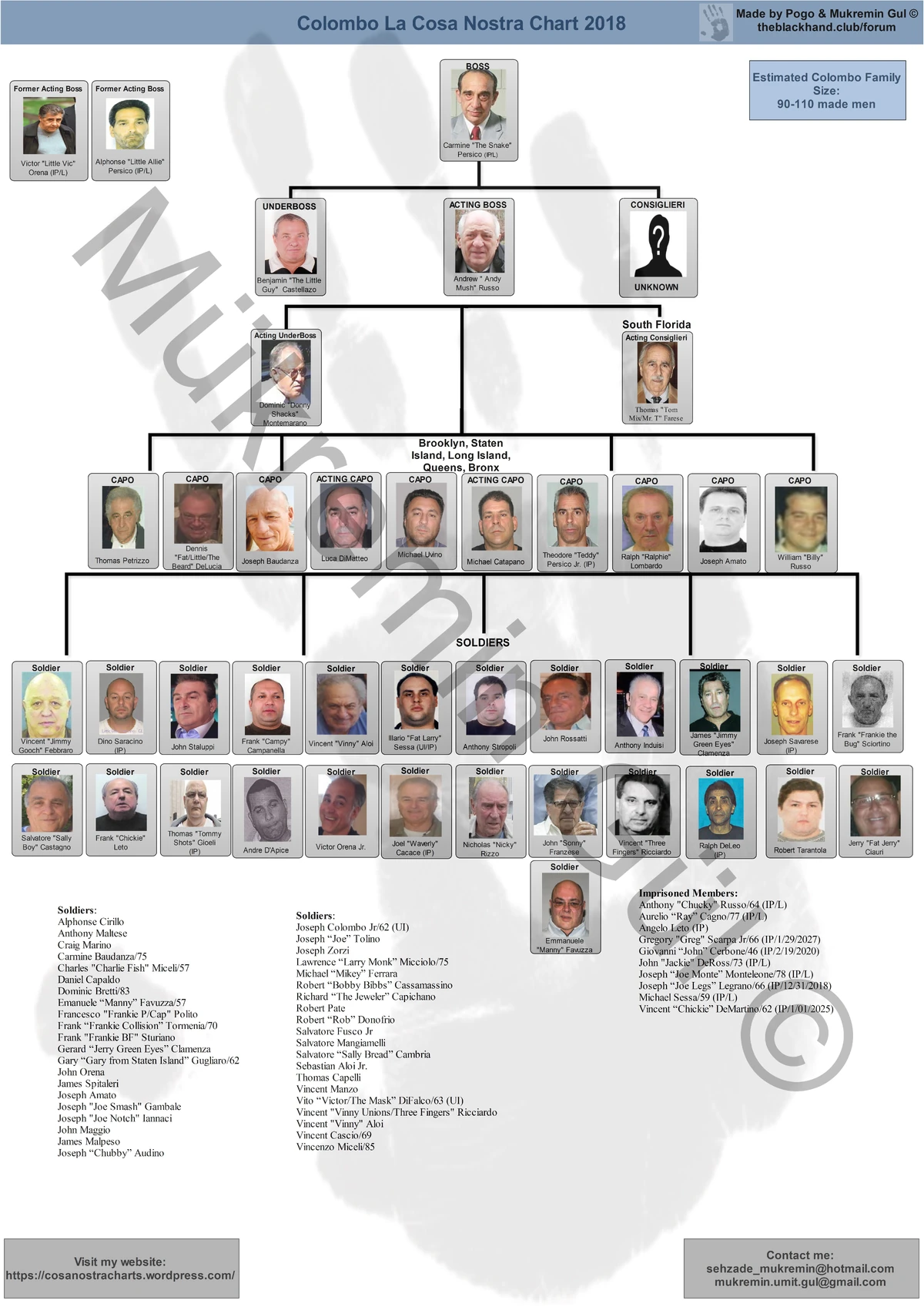
The Colombo crime family enters 2026 in a state of precarious restructuring following the devastating 2021 federal indictments that successfully targeted its entire administration. Currently, the organization is characterized by a leadership vacuum and a shift toward low-profile operations as it attempts to recover from the deaths of veteran bosses and the long-term imprisonment of its top-tier captains.
As the youngest and historically most volatile of New York City’s "Five Families," the Colombo organization has spent the last five years grappling with the fallout of a massive racketeering case involving the infiltration of a labor union healthcare fund. From the perspective of early 2026, the family remains the smallest of the La Cosa Nostra (LCN) entities in the Northeast, focused more on survival and internal stabilization than expansion.
The 2021 Decapitation and the Leadership Vacuum
The trajectory of the Colombo family in the mid-2020s was largely dictated by the events of September 2021. In a sweeping operation, federal prosecutors for the Eastern District of New York (EDNY) charged 14 defendants, including the family’s official boss, underboss, and acting consigliere. This "decapitation" strike was significant because it proved that even with the transition to more clandestine communication methods, the organization remained vulnerable to deep-cover surveillance and cooperating witnesses.
The Passing of Andrew "Andy Mush" Russo
Andrew Russo, who served as the family’s acting boss and was a cousin of the legendary Carmine "The Snake" Persico, died in April 2022 at the age of 87 while awaiting trial. His death marked the end of an era. Russo had been the unifying force attempting to keep the fractured family together after the 2019 death of Carmine Persico in federal prison. Without Russo’s seniority and family ties, the organization splintered into smaller, more autonomous crews.
The Sentencing of the Administration
By late 2023 and throughout 2024, the legal proceedings initiated in 2021 reached their logical conclusion. Benjamin "Benji" Castellazzo, the longtime underboss, and Ralph DiMatteo, the consigliere who famously fled to Florida upon learning of his indictment before surrendering, both faced significant prison time.
The Department of Justice documented that these leaders were central to a long-running scheme to extort a labor union and its affiliated healthcare fund. The removal of these figures created a "middle-management" crisis. In 2026, the family is currently managed by a "panel" or a temporary acting boss, likely chosen for their lack of a high-profile criminal record to avoid immediate law enforcement scrutiny.
Current Leadership Prospects in 2026
Identifying the exact "Boss" of the Colombo family in 2026 is complex due to the organization's deliberate lack of a formal hierarchy. Following the "Commission" trials of the 1980s and the internal wars of the 1990s, the family learned that a single, visible head is an easy target for the RICO (Racketeer Influenced and Corrupt Organizations) Act.
The Rise of the New Generation
The name most frequently cited by organized crime investigators in 2025 and 2026 is Theodore "Teddy" Persico Jr. The nephew of Carmine Persico, Teddy Jr. was released from federal prison in 2020. Unlike his predecessors, he has maintained a remarkably low profile. Analysts believe he represents the "Persico faction's" continued influence over the family’s assets. However, his ability to lead is hampered by the strict terms of his supervised release and the constant surveillance by the FBI’s C-16 squad, which specializes in the Colombo family.
Secondary Leadership and Captains
Behind the scenes, the family relies on a handful of "street bosses" and captains (caporegimes) who managed to evade the 2021 sweep. These individuals oversee crews in Brooklyn, Long Island, and parts of New Jersey. Their primary role in 2026 is "maintenance"—ensuring that traditional tribute flows upward while keeping the rank-and-file soldiers from engaging in "loud" crimes that attract media attention.
Operations: From Labor Unions to Digital Rackets
The Colombo family’s operational portfolio has evolved significantly. While they were once synonymous with violent hijackings and overt extortion, the 2026 iteration of the family is more technocratic and white-collar.
Labor Union Infiltration
The 2021 case highlighted the family's continued obsession with labor unions, specifically the Laborers' International Union of North America (LIUNA). The scheme involved forcing the union to select vendors associated with the mob for its healthcare and pension funds. By 2026, law enforcement oversight of these unions has reached an all-time high, forcing the Colombo family to seek influence in smaller, less-regulated trade associations and independent unions in the construction and waste management sectors.
Traditional Rackets and Modern Adaptation
Despite the shift toward white-collar crime, the family’s "bread and butter" remains:
- Loansharking: High-interest "juice" loans remain the family's most consistent revenue stream. In an era of fluctuating interest rates and tightening bank credit, the mob’s role as a lender of last resort for small business owners remains lucrative.
- Illegal Gambling: While legal sports betting has proliferated across the United States, the Colombo family continues to operate offshore "pay-per-head" sites. These services appeal to bettors who wish to gamble on credit or avoid the tax implications of legal platforms.
- Extortion: This has moved away from the "protection money" model of the past. Instead, it involves "labor peace" threats where contractors pay the family to avoid work stoppages or "accidents" on job sites.
Cybercrime and Cryptocurrency
Evidence emerging in 2025 indicated that younger associates within the Colombo crews have begun experimenting with cryptocurrency-based money laundering. By using decentralized finance (DeFi) protocols, they attempt to obscure the paper trail of traditional rackets. However, the FBI’s increasing sophistication in blockchain analysis has made this a risky endeavor for the organization.
Legal Status and Federal Oversight
The legal status of the Colombo family in 2026 can be described as "under a microscope." The Eastern District of New York continues to utilize the RICO Act as its primary tool for dismantling the family’s structure.
Comparison of Colombo Family Status (2021 vs. 2026)
| Feature | 2021 Status | 2026 Status (Current) |
|---|---|---|
| Leadership | Formal (Russo, Castellazzo, DiMatteo) | Informal / Panel-based |
| Primary Target | Laborers' Union Healthcare Fund | Small-scale construction & Private sanitation |
| Membership Est. | ~60-70 Made Members | ~45-55 Made Members |
| Legal Pressure | High (Active Indictments) | Very High (Supervised Release/Monitors) |
| Primary Territory | Brooklyn, Staten Island, Long Island | Long Island, Queens, New Jersey |
| Stability | Moderate | Fragile (Post-Persico transition) |
The Role of Cooperating Witnesses
The greatest threat to the Colombo family’s legal status in 2026 is the "broken wall of silence" (Omertà). The 2021 case was bolstered by high-level cooperators who provided secret recordings of induction ceremonies and planning meetings. The fear of "wires" has led to a culture of paranoia within the family, where members are often hesitant to meet in groups of more than two or three.
The Impact of the "Five Families" Dynamics
The Colombo family does not operate in a vacuum. Its survival in 2026 is partly dependent on its relationship with the more powerful Genovese and Gambino families. Historically, when the Colombo family becomes too unstable (as seen during the wars of the 1990s), the other families intervene to restore order—often by installing their own "overseers" or mediating disputes.
Currently, the Colombo family is viewed by the other four families as a "junior partner." They often share in joint ventures, particularly in construction projects where the Colombo family’s remaining union influence can be leveraged by the larger families.
Security and Surveillance in the 2020s
For the Colombo family, 2026 is a year of technical evasion. Law enforcement now uses advanced facial recognition, AI-driven pattern analysis, and sophisticated signals intelligence (SIGINT) to track mob associates.
In response, the family has reverted to "Stone Age" communication:
- Walk-talks: Conducted in open parks or near loud construction sites to thwart directional microphones.
- No-Phone Zones: Prohibition of any electronic devices during meetings.
- Human Couriers: Utilizing non-criminal associates (often relatives) to pass physical messages across boroughs.
Despite these efforts, the Federal Bureau of Investigation continues to maintain a dedicated presence in the neighborhoods where the family is most active, such as Bensonhurst and Dyker Heights.
Frequently Asked Questions
Who is the current boss of the Colombo crime family in 2026?
As of early 2026, there is no officially recognized "Boss" by law enforcement. The family is believed to be run by an acting committee or a "Street Boss" to shield the ultimate leadership from RICO prosecutions. Theodore "Teddy" Persico Jr. remains the most influential figure, though he has not been officially designated as the boss in public legal filings since his release.
Is the Colombo crime family still active in New York?
Yes, the family remains active, though its membership has dwindled to approximately 50-60 "made" members and several hundred associates. Their activity is currently focused on Long Island and Brooklyn, with a heavy emphasis on construction-related extortion and illegal gambling.
How did the 2021 indictment affect the family?
The 2021 indictment was catastrophic. It resulted in the conviction of the entire "Administration" (the top three positions). It effectively stopped their multi-year effort to take over a major labor union’s healthcare fund, which would have provided millions in recurring revenue.
What happened to Andrew Russo?
Andrew "Andy Mush" Russo died in April 2022 while awaiting trial for the 2021 racketeering charges. He was 87 years old. His death left the family without its most experienced leader and sparked the current period of restructuring.
Are the Five Families still a significant threat?
While they no longer control the city's infrastructure as they did in the mid-20th century, the FBI and the Department of Justice still categorize the Five Families, including the Colombos, as a significant threat to the economy, particularly through labor racketeering and the corruption of legitimate businesses.
Where does the Colombo family get its money in 2026?
Their revenue comes from a mix of traditional and modern sources: loansharking, offshore sports betting, extortion of small businesses, and increasingly, fraudulent schemes involving medical billing and specialized construction contracts.
Future Outlook and Recommendations
For researchers, journalists, and legal professionals tracking organized crime, the Colombo family serves as a case study in institutional resilience. Despite being "broken" multiple times by internal wars and federal prosecutions, the organization persists because it fills an economic niche in the underground economy.
Next Steps for Monitoring:
- Court Listeners: Watch for sentencing reports from the EDNY regarding 2024-2025 associates; these often contain "sentencing memos" that provide the most current updates on who is currently "made" or in a leadership position.
- BOP Inmate Tracking: Monitor the release dates of mid-level captains convicted in the 2010s, as their return to the streets often signals a shift in local crew dynamics.
- State Gaming Commission Reports: These often highlight "illegal bookmaking" rings that provide a window into the family's current financial health.
The Colombo crime family in 2026 is a shadow of its mid-century peak, but it remains a dangerous and adaptive criminal enterprise. Its future depends on whether the "New Generation" can maintain discipline in an era of unprecedented surveillance.