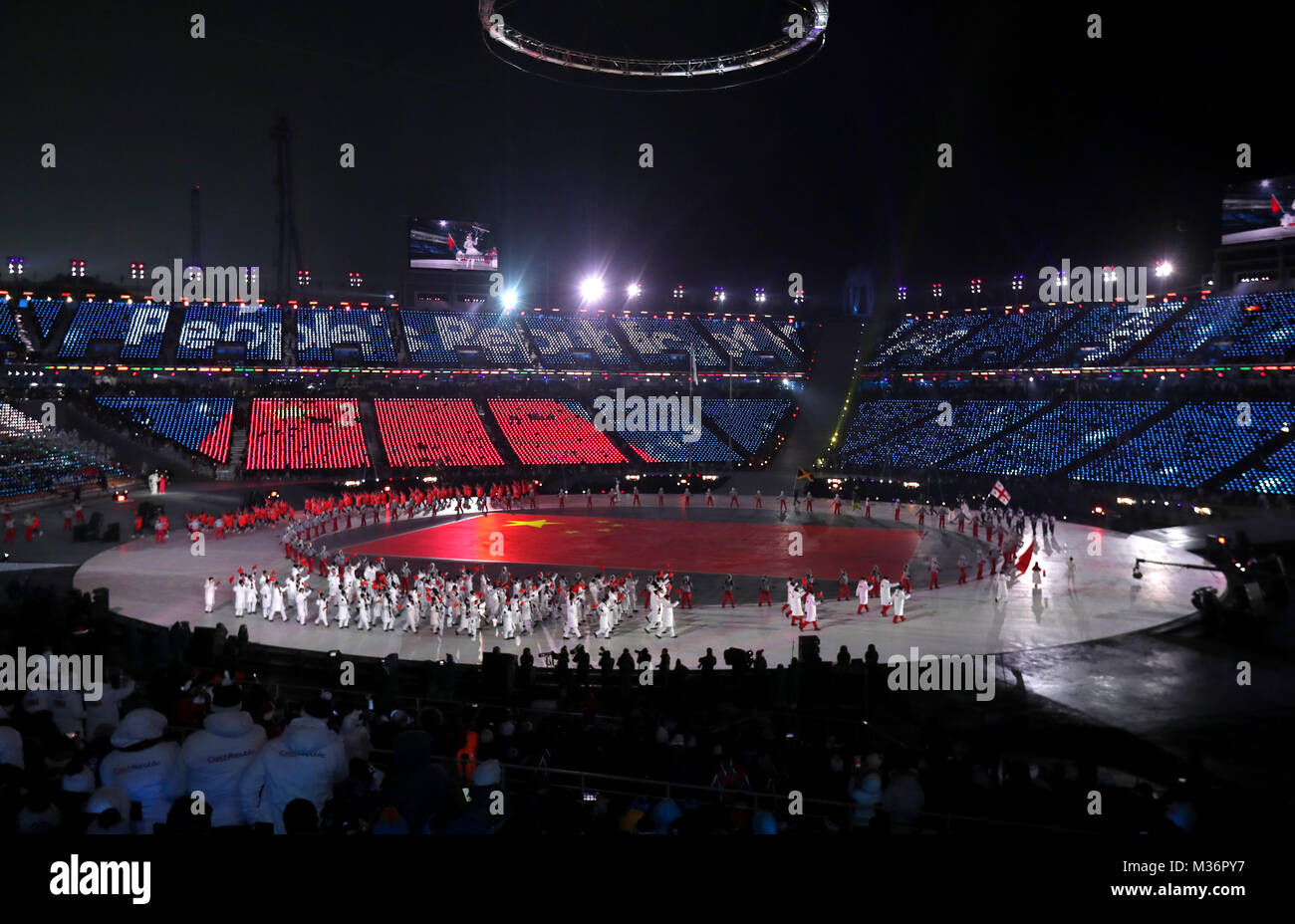
The 2018 Pyeongchang Winter Olympics Opening Ceremony, titled "Peace in Motion," was a landmark event that blended South Korea’s deep cultural heritage with futuristic technology. It is best remembered for its record-breaking 1,218-drone light show, the historic joint march of North and South Korean athletes under a unification flag, and the elegant lighting of the cauldron by figure skating legend Yuna Kim.
The ceremony, held on February 9, 2018, at the Pyeongchang Olympic Stadium, set a new standard for how host nations can utilize "soft power" to convey messages of diplomacy and technological prowess. From the perspective of 2026, the event remains a masterclass in event production, particularly in its early adoption of 5G technology and augmented reality (AR) to enhance the viewer experience.
The Architectural Stage: The Pentagonal Stadium
Unlike many Olympic venues designed for permanent use, the Pyeongchang Olympic Stadium was a purpose-built, temporary structure. Its unique pentagonal shape was not merely an aesthetic choice but a symbolic one, representing the five goals of the Pyeongchang 2018 Games: culture, environmental protection, peace, economy, and information technology.
The stadium was situated in the Daegwallyeong-myeon precinct, an area known for its harsh winter winds and sub-zero temperatures. Because the stadium lacked a roof and central heating, organizers provided every attendee with a "warmth kit" consisting of a poncho, a blanket, and various heat pads. This logistical challenge became a part of the "Pyeongchang Spectacular" narrative, showcasing the resilience of the spectators and the high-energy performances that kept the crowd engaged despite the -10°C (14°F) wind chill.
The structure was designed to be dismantled after the Paralympic Games to avoid the "white elephant" syndrome that has plagued previous host cities. By 2026, the site has been largely repurposed, but the legacy of that pentagonal footprint remains a significant case study in sustainable Olympic planning.
"Peace in Motion": The Narrative of the Five Children
The creative heart of the ceremony followed the journey of five children—Ha-yan, Ju-won, Narae, Sae-bom, and Woong—each representing one of the five natural elements (fire, water, wood, metal, and earth) and the five Olympic rings. Their journey through time served as a bridge between Korea’s ancient past and its high-tech future.
The Mythological Origins
The ceremony began with the ringing of a massive bell, a digital and physical representation of the Sangwonsa Bell. As the children traveled through a snowy landscape, they encountered creatures from Korean mythology, most notably the White Tiger (Soohorang), which served as the official mascot of the Games. The use of traditional puppetry combined with floor projections created a 360-degree immersive environment that depicted the "Land of Peace."
The Modern Transformation
As the narrative progressed, the children moved from the agrarian and spiritual roots of Korea into a hyper-connected urban landscape. This segment emphasized South Korea’s rapid evolution from a war-torn nation to a global leader in innovation. The transition was marked by synchronized choreography and the use of LED costumes, signaling the "ICT Olympics" (Information and Communication Technology) theme that Pyeongchang championed.
A Technical Marvel: The Record-Breaking Drone Show
One of the most enduring images of the Pyeongchang spectacular was the appearance of a giant, glowing snowboarder in the night sky, which then transformed into the five Olympic rings. This was achieved through a fleet of 1,218 Intel Shooting Star drones.
Engineering the Spectacle
The drone show set a Guinness World Record at the time for the most Unmanned Aerial Vehicles (UAVs) flown simultaneously. Each drone acted as a single pixel in a massive 3D aerial display. The technical depth required for this feat included:
- Centralized Control: A single pilot and a single computer controlled the entire fleet.
- Precise Geofencing: To prevent collisions, each drone utilized high-precision GPS and sophisticated algorithms to maintain its place in the formation.
- Weather Resistance: While the live segment used a smaller number of drones due to extreme wind conditions, the pre-recorded 1,218-drone sequence remains a benchmark in aerial choreography.
For the global audience watching in 2018, this was an introduction to a new form of entertainment that has since replaced traditional fireworks in many international celebrations. From our vantage point in 2026, we can see how this specific moment in Pyeongchang accelerated the commercial and artistic use of drone swarms worldwide.
The Diplomacy of the Joint March
The 2018 Opening Ceremony was as much a political event as it was a sporting one. In a moment that garnered global headlines, athletes from North Korea and South Korea marched together during the Parade of Nations.
The Unification Flag
The athletes entered the stadium behind a single "Unification Flag"—a blue silhouette of the Korean Peninsula on a white background. This joint entrance was the result of months of high-level negotiations and served as a powerful symbol of the "Peace Games." It was the first time the two nations had marched together at an Olympics since the 2006 Winter Games in Turin.
High-Level Attendance
The significance of the moment was amplified by the presence of high-ranking officials in the VIP stands. Moon Jae-in, then-President of South Korea, was seen shaking hands with Kim Yo-jong, the sister of North Korean leader Kim Jong-un. This "Olympic Truce" provided a rare window of diplomatic engagement during a period of high tension on the peninsula. While the long-term political impacts remained complex, the Opening Ceremony successfully projected a vision of reconciliation to billions of viewers.
The Lighting of the Cauldron: Yuna Kim’s Finale
The climax of any opening ceremony is the lighting of the Olympic cauldron, and Pyeongchang’s finale was executed with unparalleled grace. The final torchbearers included members of the unified Korean women’s hockey team, who carried the flame up a massive staircase to the base of the cauldron.
Waiting there was Yuna Kim, the 2010 Olympic gold medalist and a national icon in South Korea. Kim performed a brief, elegant figure skating routine on a small ice rink at the top of the stadium before receiving the flame.
The Cauldron Design
The cauldron itself was inspired by traditional Korean white porcelain "moon jars" (Dalhangari), which represent the beauty of the moon and the warmth of the Korean people. As Kim lit a hidden mechanism, a pillar of fire rose through a series of kinetic rings to ignite the main vessel. The design was both minimalist and technologically sophisticated, reflecting the dual nature of the entire ceremony.
Comparative Overview: Pyeongchang vs. Other Winter Games
To understand the scale of the Pyeongchang spectacular, it is helpful to compare it to the ceremonies that preceded and followed it.
| Feature | Sochi 2014 | Pyeongchang 2018 | Beijing 2022 |
|---|---|---|---|
| Main Theme | Russian History & Soul | Peace in Motion | One World, One Family |
| Stadium Type | Permanent (Fisht) | Temporary (Pentagonal) | Permanent (Bird's Nest) |
| Key Tech | Massive Floats | Drone Swarms & AR | Giant LED Floor (11,600 sqm) |
| Temp at Start | 4°C (40°F) | -6°C (21°F) | -3°C (26°F) |
| Notable Moment | Unopened Ring Glitch | Joint Korean March | Snowflake Cauldron |
Cultural Impact and Legacy in 2026
As we look back from 2026, the 2018 Opening Ceremony is viewed as the moment South Korea solidified its status as a "cultural superpower." This event took place just as the "Korean Wave" (Hallyu) was reaching its peak global saturation. The inclusion of K-pop, traditional pansori singing, and world-class digital art during the ceremony served as a preview of the cultural dominance Korea would continue to exert throughout the early 2020s.
Furthermore, the "Pyeongchang Spectacular" proved that a Winter Olympics could be successful in a non-traditional winter sports market through the use of imaginative storytelling and technological integration. The lessons learned from the Pyeongchang drone show and AR implementations have since become standard requirements for any city bidding to host future Games.
Frequently Asked Questions
What was the temperature during the 2018 Pyeongchang Opening Ceremony?
The temperature at the start of the ceremony was approximately -6°C (21°F), but with the wind chill factor, it felt closer to -10°C (14°F). It was widely considered one of the coldest Olympic Opening Ceremonies in history. Organizers mitigated this by providing "warmth kits" to all 35,000 spectators and installing wind shields around the stadium.
Did North and South Korea compete as one team in 2018?
While they marched together in the Opening Ceremony and formed a unified women’s ice hockey team, the two nations competed as separate Olympic Committees for most other events. The joint march was a symbolic gesture of peace rather than a full athletic merger.
Was the 1,218-drone show live?
The spectacular 1,218-drone formation of the Olympic rings seen on the global broadcast was pre-recorded for safety and technical stability, primarily due to the unpredictable winds in the Pyeongchang mountains. However, a smaller-scale live drone performance was conducted for the stadium audience during the ceremony.
What happened to the Pyeongchang Olympic Stadium?
As planned, the $100 million stadium was largely demolished shortly after the 2018 Winter Paralympics. The site was converted into a memorial park and a smaller permanent museum dedicated to the 2018 Games, fulfilling the commitment to avoid long-term maintenance costs for an unused venue.
Who directed the 2018 Opening Ceremony?
The ceremony was directed by Song Seung-whan, a well-known actor and theater producer famous for creating the non-verbal percussion show "Nanta." His background in theatrical production was evident in the rhythmic and visual pacing of the event.
Final Recommendation
For those interested in the intersection of technology and culture, the 2018 Winter Olympics Opening Ceremony remains a vital study. If you wish to experience the "spectacular" today, the official Olympic YouTube channel maintains high-definition footage of the full event. Analyzing the "Peace in Motion" narrative provides deep insight into how South Korea successfully utilized a global sporting platform to communicate its past, present, and future aspirations. Whether you are an event planner, a historian, or a sports fan, the Pyeongchang ceremonies offer a timeless example of how to execute a complex, multi-layered vision under extreme environmental conditions.