Mastering conversions between fractions, decimals, and percentages unlocks a foundational mathematical skill essential for academic success, financial literacy, and everyday problem-solving. This guide explores the core principles, manual calculations, systematic conversion pathways, and real-world applications required to navigate these numeric forms with confidence and precision.
Understanding the Trio: Fractions, Decimals, and Percentages
At the heart of numerical literacy lies the realization that fractions, decimals, and percentages are merely three different languages expressing the exact same mathematical value. When you say one-half, you can write it as a fraction ($1/2$), a decimal ($0.5$), or a percentage ($50%$). Understanding how these three forms relate prevents calculation errors and builds the structural intuition necessary for advanced mathematics, algebra, and practical financial management.
A fraction represents a part of a whole, broken down into a numerator (the top number indicating how many parts you have) and a denominator (the bottom number indicating the total equal parts in that whole). Decimals are an extension of our base-10 place-value system, where each position to the right of the decimal point represents a power of ten (tenths, hundredths, thousandths). Percentages, derived from the Latin per centum, literally mean "per one hundred," representing a proportion out of a total of $100$.
Recognizing that these forms are interchangeable allows you to choose the most efficient format for any given scenario. For instance, computing a discount in a retail store is often easiest using percentages converted to decimals, whereas sharing a recipe or measuring building materials typically relies on fractions. Bridging these formats requires mastering specific mathematical operations, moving fluidly from one representation to another without altering the underlying value.
The Foundation of Fraction Mechanics
Before converting fractions to decimals or percentages, you must understand how fractions operate, simplify, and maintain equivalence. A fraction is in its simplest form when the greatest common divisor (GCD) of both the numerator and the denominator is $1$. Simplifying fractions—often called reducing them—is a mandatory prerequisite for clean conversions and precise algebra.
To simplify a fraction, find the GCD of the top and bottom numbers and divide both by that number. For example, to simplify $24/32$, identify that $8$ is the largest integer that divides evenly into both $24$ and $32$. Dividing $24$ by $8$ yields $3$, and dividing $32$ by $8$ yields $4$, resulting in the simplified equivalent fraction $3/4$.
Fractions also appear in two primary structural types: proper and improper. A proper fraction has a numerator smaller than its denominator, representing a value less than $1$. An improper fraction has a numerator larger than or equal to its denominator, representing a value greater than or equal to $1$. Improper fractions can also be written as mixed numbers, which combine a whole number and a proper fraction (such as $1 \frac{1}{4}$). When converting to decimals or percentages, converting mixed numbers into improper fractions first ensures calculation accuracy.
Converting Fractions to Decimals and Percentages
Converting a fraction into a decimal is fundamentally an exercise in division. Because a fraction bar ($/$) denotes division, the numerator is always divided by the denominator. Executing this division—either manually via long division or using a calculator—yields the decimal equivalent.
Take the fraction $3/8$. To convert this into a decimal, divide $3$ by $8$. Since $3$ is smaller than $8$, add a decimal point and zeros ($3.000$) to carry out the long division:
- $8$ goes into $30$ three times ($3 \times 8 = 24$), leaving a remainder of $6$.
- Bring down another zero to make $60$. $8$ goes into $60$ seven times ($7 \times 8 = 56$), leaving a remainder of $4$.
- Bring down one more zero to make $40$. $8$ goes into $40$ five times ($5 \times 8 = 40$), with a remainder of $0$. Thus, $3/8$ equals $0.375$.
Once you have established the decimal, converting it to a percentage is straightforward: multiply the decimal value by $100$ and append the percent sign ($%$). Multiplying by $100$ shifts the decimal point two places to the right. Therefore, $0.375$ multiplied by $100$ becomes $37.5%$.
| Fraction | Long Division Step | Decimal Form | Percentage Form |
|---|---|---|---|
| $1/4$ | $1 \div 4$ | $0.25$ | $25%$ |
| $3/5$ | $3 \div 5$ | $0.6$ | $60%$ |
| $7/8$ | $7 \div 8$ | $0.875$ | $87.5%$ |
| $2/3$ | $2 \div 3$ | $0.666...$ | $66.67%$ |
Converting Decimals to Fractions and Percentages
Reversing the process requires understanding place value. Every terminating decimal can be converted directly into a fraction by placing the decimal digits over their corresponding place-value denominator (such as $10$, $100$, or $1,000$) and then reducing the fraction to its simplest terms.
Consider the decimal $0.65$. Because the final digit ($5$) resides in the hundredths place, write the number without the decimal point over $100$: $$\frac{65}{100}$$ To simplify this fraction, find the greatest common divisor of $65$ and $100$, which is $5$. Divide both the numerator and denominator by $5$: $$\frac{65 \div 5}{100 \div 5} = \frac{13}{20}$$ Therefore, the decimal $0.65$ converts to the fraction $13/20$.
Converting a decimal to a percentage follows the same rule established earlier: multiply the decimal value by $100$ (shifting the decimal point two places right) and add the percent sign. For example, $0.65 \times 100 = 65%$. If you are dealing with a repeating decimal, such as $0.333...$, recognize its fractional equivalent ($1/3$) and its percentage equivalent ($33.33%$) to maintain mathematical precision in professional or academic contexts.
Converting Percentages to Decimals and Fractions
Percentages represent parts out of $100$, making them the easiest format to translate once you remember to account for the scale factor. To convert a percentage to a decimal, remove the percent sign and divide the number by $100$, which shifts the decimal point two places to the left.
For instance, converting $85%$ to a decimal involves dividing $85$ by $100$, resulting in $0.85$. If the percentage includes a decimal value, such as $4.5%$, the same rule applies: move the decimal point two places to the left, filling empty spaces with a zero, yielding $0.045$.
To convert a percentage into a fraction, place the percentage number over a denominator of $100$ and simplify. Taking $75%$ as an example: $$\frac{75}{100}$$ Both $75$ and $100$ are divisible by $25$. Dividing both by $25$ gives: $$\frac{3}{4}$$ By mastering this bidirectional flow, you can seamlessly translate any numerical expression into the format that best suits your immediate calculation needs.
Common Conversion Reference Table
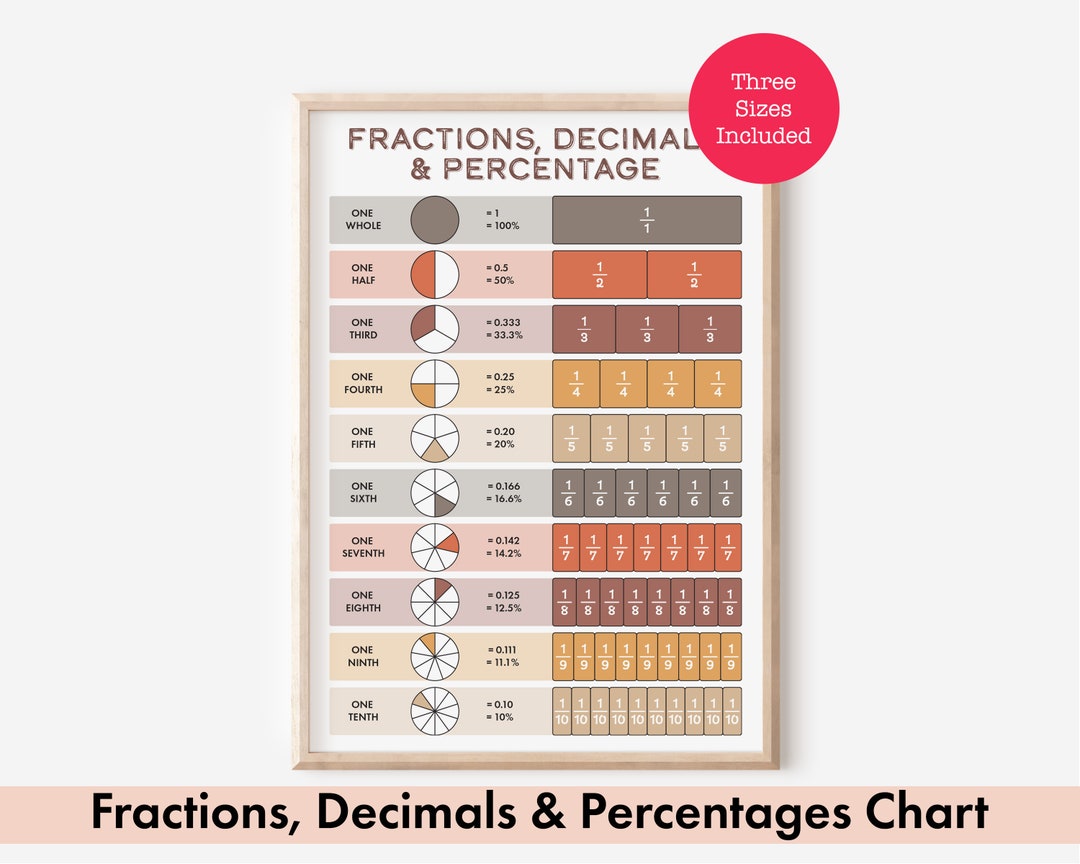
Having a mental inventory of common conversions accelerates problem-solving and reduces reliance on external tools. The table below outlines standard fractions, their corresponding decimal values, and equivalent percentages frequently encountered in daily life, finance, and academics.
| Fraction | Decimal | Percentage | Common Application |
|---|---|---|---|
| $1/10$ | $0.1$ | $10%$ | Basic scaling, tipping |
| $1/8$ | $0.125$ | $12.5%$ | Engineering tolerances |
| $1/5$ | $0.2$ | $20%$ | Discounts, tax rates |
| $1/4$ | $0.25$ | $25%$ | Financial quarters |
| $1/3$ | $0.333...$ | $33.33%$ | Proportional shares |
| $1/2$ | $0.5$ | $50%$ | Halving quantities |
| $2/3$ | $0.666...$ | $66.67%$ | Two-thirds majority |
| $3/4$ | $0.75$ | $75%$ | Three-quarter milestones |
| $9/10$ | $0.9$ | $90%$ | Test scores, probabilities |
Advanced Conversion Scenarios: Repeating Decimals and Mixed Numbers
While converting terminating decimals is straightforward, dealing with repeating decimals requires algebraic manipulation to ensure absolute accuracy. A repeating decimal features one or more digits that continue infinitely in a predictable pattern, such as $0.454545...$ or $0.1666...$.
To convert a repeating decimal into a fraction, use an algebraic equation. Let $x$ equal the repeating decimal: $$x = 0.636363...$$ Because two digits ($6$ and $3$) repeat, multiply both sides of the equation by $10^2$ (or $100$): $$100x = 63.636363...$$ Next, subtract the original equation ($x = 0.636363...$) from the multiplied equation: $$100x - x = 63.636363... - 0.636363...$$ $$99x = 63$$ Solve for $x$ by dividing both sides by $99$: $$x = \frac{63}{99}$$ Finally, simplify the fraction by dividing the numerator and denominator by their greatest common divisor, which is $9$: $$x = \frac{7}{11}$$ This systematic approach ensures that you never lose precision by rounding off repeating decimals prematurely.
Real-World Applications: Finance, Cooking, and Engineering
Conversion fluency is not merely an academic exercise; it is an essential practical tool across diverse industries and daily scenarios. In personal finance, calculating interest rates, investment yields, and loan amortizations requires moving constantly between percentages and decimals. For example, an annual percentage rate (APR) of $5.5%$ must be converted to the decimal $0.055$ and divided by $12$ to compute monthly compounding interest accurately.
In culinary arts and baking, recipes often demand precise adjustments. If a recipe calls for scaling down by $35%$, a chef must convert that percentage to the decimal $0.35$ or the fraction $7/20$ to multiply against every ingredient weight. Failing to convert correctly ruins hydration ratios, baking chemistry, and final product texture.
Engineering and construction trades rely heavily on fraction-decimal conversions. Blueprint measurements are frequently written in fractional inches (such as $3 \text{ } 5/16$ inches), whereas digital computer-aided design (CAD) software and CNC machining tools require decimal inch notation ($3.3125$ inches). Precision machining tolerances leave zero margin for error, making rapid, accurate conversion a core professional competency.
Common Pitfalls and Troubleshooting Conversion Errors
Even experienced professionals occasionally trip over specific numerical edge cases. Recognizing these common mistakes helps you catch errors before they impact calculations or project outcomes.
- Forgetting the Place-Value Shift: When converting percentages to decimals, a frequent error is moving the decimal point only one place instead of two. For example, treating $5%$ as $0.5$ instead of the correct value, $0.05$, introduces a tenfold calculation error.
- Premature Rounding: Rounding repeating decimals like $1/3$ to $0.33$ too early in a multi-step calculation accumulates significant rounding error. Always retain full fractional values or carry decimals out to at least four places until the final step of your calculation.
- Ignoring Denominator Alignment: When adding or comparing fractions converted from percentages, ensure you do not mix up base values. A percentage is always calculated relative to a base of $100$, whereas fractions can have any denominator. Always normalize fractions to a common denominator before performing addition or subtraction.
Frequently Asked Questions
What is the fastest way to convert a fraction to a percentage?
Divide the numerator by the denominator to find the decimal, then multiply that decimal by $100$ by shifting the decimal point two places to the right. For example, $1/4$ becomes $0.25$, which equals $25%$. Memorizing common conversions from a reference table also accelerates this process.
How do I handle percentages greater than 100%?
Treat percentages over $100%$ using the exact same mathematical rules. Divide by $100$ to find the decimal, or place the number over $100$ to create an improper fraction. For example, $250%$ converts to the decimal $2.5$ and the improper fraction $250/100$, which simplifies to $5/2$ or $2 \frac{1}{2}$.
Why do some decimals repeat infinitely?
Repeating decimals occur when a fraction's denominator contains prime factors other than $2$ and $5$ (the prime factors of our base-10 numbering system). When you divide the numerator by the denominator, the remainder never reaches zero, creating an infinite, repeating loop of digits.
Can all decimals be written as fractions?
Every terminating decimal and every repeating decimal can be written as a fraction (known mathematically as a rational number). Only non-repeating, non-terminating decimals—such as $\pi$ ($3.14159...$) or $\sqrt{2}$—cannot be expressed as simple fractions of two integers.
How do mixed numbers affect percentage conversions?
Convert the mixed number into an improper fraction first before calculating its decimal or percentage value. For example, to convert $1 \frac{1}{4}$, change it to $5/4$. Divide $5$ by $4$ to get $1.25$, and multiply by $100$ to arrive at $125%$.
Conclusion and Next Actions
Achieving mastery in fraction, decimal, and percentage conversion transforms numbers from abstract obstacles into predictable, manageable tools. Begin by memorizing the most common benchmark conversions, practice manual long division for unfamiliar fractions, and always verify your work by cross-referencing alternative formats. Integrate these conversion steps into your daily routines—such as calculating tips, reviewing financial statements, or measuring materials—to solidify your numerical fluency permanently.