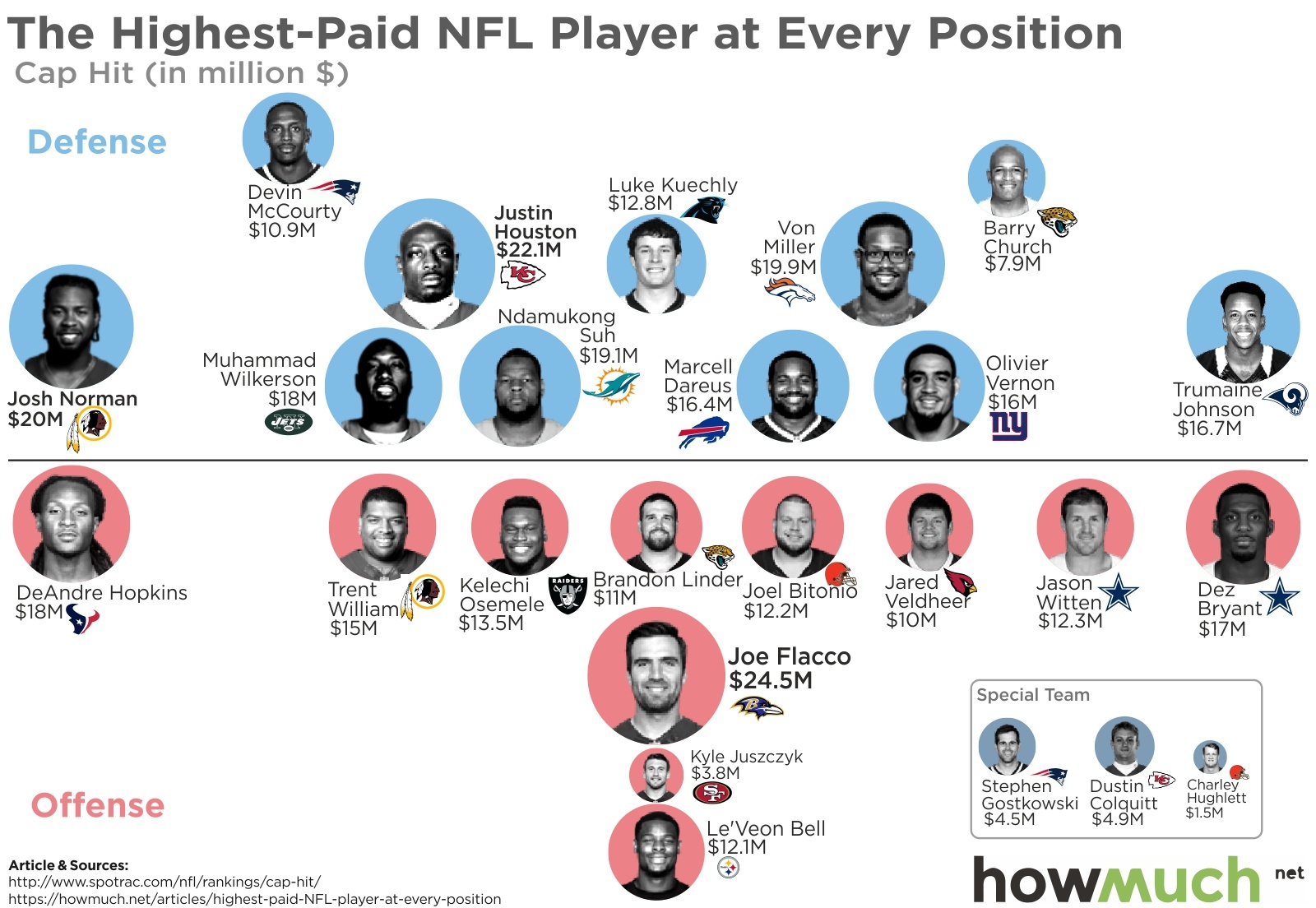
The average NFL player salary typically ranges between $2.8 million and $3.5 million annually, depending on the specific roster designation, collective bargaining agreements, and contract structures. However, this headline figure conceals massive financial polarization, where elite quarterbacks and pass rushers secure upwards of $50 million per year while rookie minimum salaries sit near $795,000. Understanding what National Football League players earn requires looking beyond league averages to examine minimum salaries, positional disparities, contract guarantees, and the broader economic structures governing professional football.
The Reality of NFL Compensation: Averages Versus Medians
When evaluating professional sports compensation, the word "average" can be misleading. In the NFL, a small group of elite superstars skews the arithmetic mean upward, making the median salary a more accurate reflection of what a typical roster player actually takes home.
To understand these figures properly, analysts differentiate between total league payroll, average annual value (AAV), and the median earnings of a standard roster player. While the mean player salary often hovers around $3 million per year, the median player—typically a veteran role player or mid-tier starter—earns closer to $1.1 million to $1.5 million. Furthermore, non-guaranteed contracts mean that a player's signed salary rarely matches their career earnings. Roster cuts, injuries, and performance clauses dictate that actual career lengths are remarkably short, averaging just over three years.
The Impact of the Collective Bargaining Agreement (CBA)
Every financial figure in professional football stems from the Collective Bargaining Agreement negotiated between the NFL and the NFL Players Association (NFLPA). Under the current CBA, players receive a guaranteed share of total league revenues, known as the "Total Gross Revenues" (TGR). This share typically ranges between 48% and 48.8%.
As league revenues soar due to massive media rights packages, ticket sales, sponsorships, and merchandise, the overall salary cap expands year-over-year. This expansion directly lifts the baseline compensation for all players, establishing higher minimum salaries across every tier of seniority.
Breaking Down NFL Minimum Salaries by Experience
The foundational bedrock of professional football economics is the rookie minimum salary. Unlike major league baseball or the NBA, where top draft picks immediately sign massive, fully guaranteed mega-contracts, NFL rookie contracts are strictly slotted based on draft position.
For undrafted free agents and late-round picks, the financial reality is starkly different from first-round selections. The NFL establishes a sliding scale of minimum salaries based strictly on accrued seasons in the league. A player with zero accrued seasons earns a different base rate than a player with five or ten years of service.
| Accrued Seasons | Minimum Base Salary (Approximate Baseline) |
|---|---|
| Rookie (0 Seasons) | $795,000 |
| 1 Season | $855,000 |
| 2 Seasons | $915,000 |
| 3 Seasons | $985,000 |
| 4 to 6 Seasons | $1.125 million to $1.25 million |
| 7+ Seasons (Veteran Minimum) | $1.21 million and above |
These baseline figures represent standard compensation before signing bonuses, workout bonuses, and performance incentives are factored into the equation.
Positional Disparities: Supply, Demand, and Value
Not all positions on the football field are compensated equally. The economic law of supply and demand heavily dictates positional value, with premium positions commanding a massive percentage of a team's total salary cap.
Offensive Premium: Quarterbacks, Tackles, and Receivers
The quarterback position stands entirely alone in professional sports economics. Elite signal-callers routinely command contracts exceeding $55 million in average annual value, with total contract values surpassing $250 million. Teams view elite quarterback play as essential to winning championships, driving up their market value exponentially.
Surrounding the quarterback, offensive tackles and wide receivers represent the next highest-paid tiers. Protecting the quarterback's blind side against elite pass rushers requires rare athletic traits, making top-tier left tackles nearly as valuable as quarterbacks. Similarly, explosive wide receivers who can stretch the field command multi-year extensions averaging $25 million to $30 million annually.
Defensive Powerhouses: Pass Rushers and Cornerbacks
On the defensive side of the ball, edge rushers and shutdown cornerbacks command the highest market share. Disrupting the opposing quarterback is the second most important objective in modern football strategy, elevating defensive ends and outside linebackers into the top salary brackets. Conversely, positions like interior offensive linemen, inside linebackers, running backs, and safeties have experienced relative salary stagnation due to positional devaluation and high replacement availability in the draft.
Guaranteed Money Versus Total Contract Value
A critical nuance in analyzing average NFL player salary is the distinction between total contract value and guaranteed money. Unlike Major League Baseball or the National Basketball Association, where standard player contracts are fully guaranteed upon signing, NFL contracts contain very little structural security.
When a team announces a player has signed a four-year, $100 million contract, that headline figure is rarely guaranteed. Only the signing bonus and specific salary components guaranteed for injury or skill are locked in. If a player suffers a career-ending injury or experiences a sharp decline in performance, the team can cut them before the guaranteed triggers activate, leaving the player without the remainder of the contract.
- Signing Bonuses: Paid upfront and prorated across the life of the contract for salary cap purposes. This money is 100% guaranteed.
- Base Salaries: Can be non-guaranteed, meaning a team can release a player in the offseason without owing the remaining base salary.
- Guaranteed for Injury: Protects the player if they cannot play due to a football-related injury, but does not protect against poor performance or coaching changes.
- Fully Guaranteed Contracts: Increasingly common among elite quarterbacks (such as Deshaun Watson or Joe Burrow), but rare for standard roster players.
Taxes, Agents, and Expenses: What Players Actually Take Home
A gross salary of $3 million does not translate to a $3 million net deposit. Professional football players face a complex array of financial deductions that significantly reduce their take-home pay.
The "Jock Tax" and State Income Taxes
Because NFL players travel across the country to play games in different states, they are subject to state and local income taxes in every jurisdiction where they play a game—a concept commonly known as the "jock tax." A player for a team in Florida or Texas (no state income tax) will still owe income tax when playing a game in California, New York, or Pennsylvania.
Agent Fees and Union Dues
NFL agents are legally capped by the NFLPA on the percentage they can charge clients, typically taking between 1.5% and 3% of playing contract earnings (and up to 5% for marketing and endorsement deals). Additionally, players pay union dues to fund the NFLPA's operations, legal protections, and player benefits.
Training Expenses and Lifestyle Costs
To maintain elite physical condition, players invest heavily out-of-pocket in private trainers, specialized nutritionists, physical therapists, and recovery equipment during the offseason. High-end housing, travel, and personal security also contribute to substantial annual overhead expenses.
Frequently Asked Questions About NFL Salaries
What is the absolute lowest a player can make in the NFL?
The absolute lowest a player can make is the rookie minimum salary established by the Collective Bargaining Agreement. For the current league year, this baseline starts at approximately $795,000 for players on a standard 53-man active roster, while practice squad players earn a separate, lower weekly rate.
Do practice squad players get paid?
Yes. Practice squad players earn a weekly salary that scales based on their accrued seasons. Veterans with multiple years of experience earn a significantly higher weekly rate on the practice squad than undrafted rookies, though these figures are substantially lower than active roster minimums.
Why do NFL contracts have void years?
Front offices use "void years" to artificially extend the length of a contract for salary cap purposes. By spreading a signing bonus across extra years that automatically void before they occur, teams can lower a player's current cap hit, pushing financial obligations into future salary cap cycles.
How are NFL salaries funded?
NFL salaries are paid directly by the individual franchise owners. However, the funding for these contracts is heavily supported by massive league-wide revenue sharing, including national television broadcast deals, league sponsorship agreements, and shared ticket revenue.
Do players get paid during the offseason?
No. NFL players are paid exclusively during the regular season, typically broken down into 17 or 18 weekly game checks. They do not receive standard base salary payments during the offseason months, which makes financial planning and budgeting essential for sustaining their lifestyles year-round.
Practical Next Steps for Following NFL Economics
For fans, researchers, and sports business analysts tracking player compensation, relying on verified data sources ensures accurate analysis. Monitoring official league announcements, NFLPA salary disclosures, and cap accounting platforms like Spotrac or OverTheCap provides transparent, up-to-date insight into how franchise payrolls operate. When evaluating contract reports, always separate total headline figures from guaranteed money to understand the true financial commitment between teams and players.