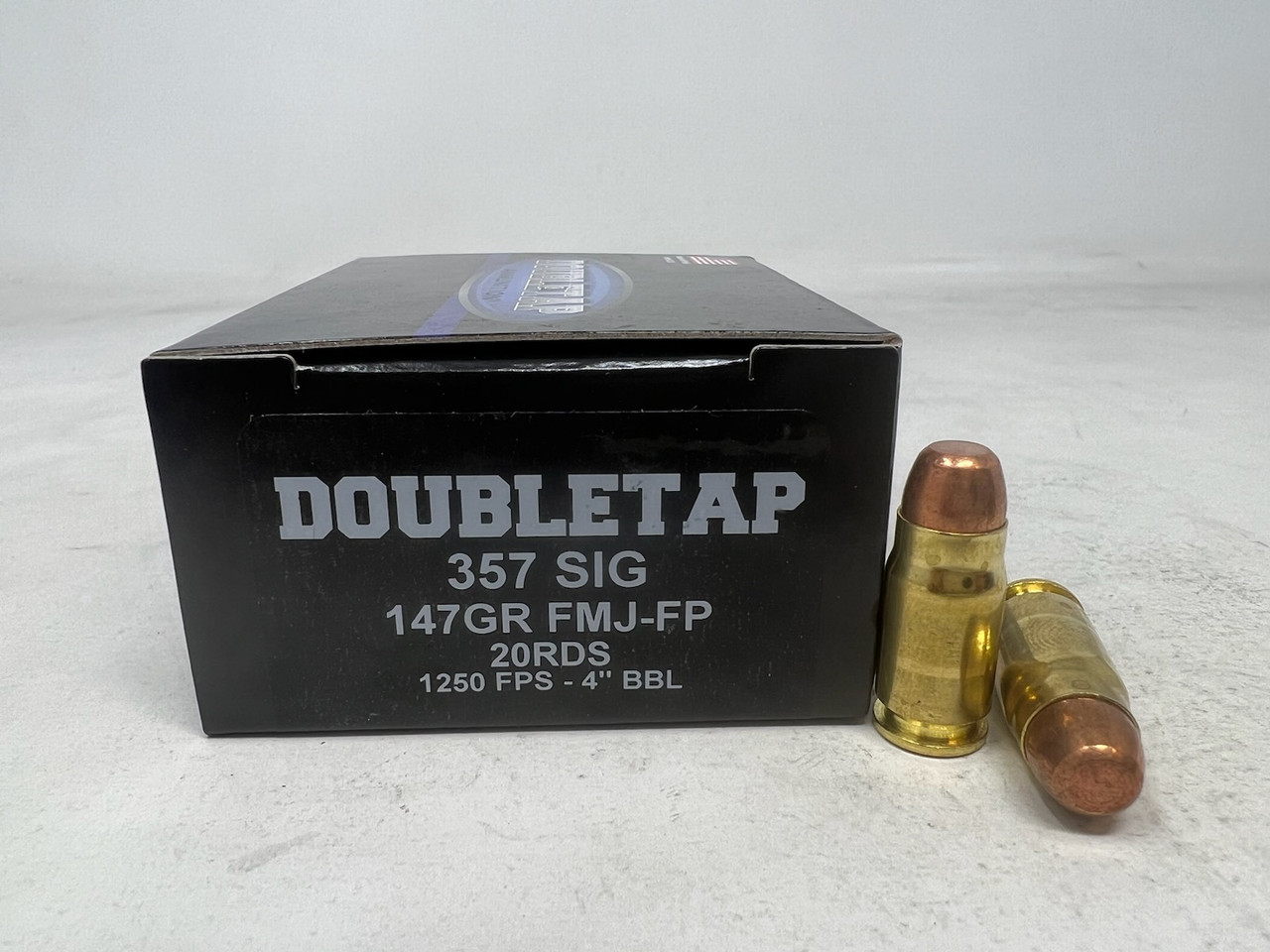
The .357 SIG is a high-velocity, bottlenecked handgun cartridge designed to replicate the terminal ballistics of a 125-grain .357 Magnum revolver load within a semi-automatic pistol platform. Developed in 1994 through a collaboration between SIG Sauer and Federal Premium, it provides exceptional barrier penetration and a flat trajectory, making it a specialized choice for professionals and enthusiasts in 2026.
The Origins and Design Philosophy of .357 SIG
The early 1990s was a period of significant transition for American law enforcement. Agencies were moving away from the traditional double-action revolver toward semi-automatic pistols, seeking higher ammunition capacity and faster reload times. However, many veteran officers were reluctant to give up the proven "man-stopping" reputation of the .357 Magnum, specifically the 125-grain Jacketed Hollow Point (JHP) load, which was widely considered the gold standard for defensive effectiveness.
To bridge this gap, SIG Sauer partnered with Federal Cartridge to create a cartridge that could offer revolver-like ballistics in a high-capacity semi-automatic. The result, released in 1994, was the .357 SIG.
Technically, the cartridge is often described as a .40 S&W case necked down to accept a .355-inch (9mm) bullet. However, this is a slight oversimplification. Because a .40 S&W case is slightly too short to provide adequate neck tension on a 9mm projectile once necked down, the .357 SIG case is actually slightly longer than a .40 S&W case. This design allows for a bottlenecked profile, which offers several distinct mechanical advantages, including incredibly reliable feeding. The tapered shape of the cartridge acts like a funnel, guiding the round into the chamber with a much lower probability of "nose-diving" or failing to feed compared to straight-walled cartridges like the 9mm or .45 ACP.
Technical Specifications and Ballistic Profile
The .357 SIG is a high-pressure cartridge. According to the Sporting Arms and Ammunition Manufacturers' Institute (SAAMI), the maximum pressure for .357 SIG is set at 40,000 psi. For comparison, the standard 9mm Luger is rated at 35,000 psi, and even 9mm +P only reaches 38,500 psi. This high pressure is what generates the cartridge’s signature velocity.
Velocity and Kinetic Energy
A standard .357 SIG load typically pushes a 125-grain bullet at muzzle velocities ranging from 1,350 to 1,500 feet per second (fps), depending on barrel length. This results in muzzle energy figures between 500 and 600 foot-pounds (ft-lbs).
In contrast:
- 9mm Luger (124-grain): Typically travels at 1,150 fps with roughly 360 ft-lbs of energy.
- .40 S&W (180-grain): Typically travels at 1,050 fps with roughly 440 ft-lbs of energy.
The .357 SIG's higher velocity contributes to a flatter trajectory over longer distances. While most defensive encounters occur at very close range, the ability to accurately engage targets at 50 yards and beyond with minimal bullet drop is a significant advantage for specific law enforcement roles and rural self-defense.
Barrier Penetration
One of the primary reasons the .357 SIG gained a foothold in law enforcement was its "barrier blindness." High-velocity projectiles tend to perform more consistently when passing through obstacles like automotive glass (windshields) and heavy clothing. While 9mm and .40 S&W have improved significantly with modern bullet technology, the sheer kinetic energy of the .357 SIG allows it to maintain its path and expansion characteristics more reliably after breaching a hard barrier.
Comparative Performance Table
The following table compares the .357 SIG against its primary competitors in the semi-automatic and revolver markets, using standard duty-grade ammunition specifications.
| Cartridge | Typical Bullet Weight (gr) | Muzzle Velocity (fps) | Muzzle Energy (ft-lbs) | SAAMI Max Pressure (psi) |
|---|---|---|---|---|
| .357 SIG | 125 | 1,450 | 583 | 40,000 |
| 9mm Luger | 124 | 1,150 | 364 | 35,000 |
| 9mm Luger +P | 124 | 1,200 | 396 | 38,500 |
| .40 S&W | 180 | 1,050 | 441 | 35,000 |
| .357 Magnum | 125 | 1,450 | 583 | 35,000 |
| .45 ACP | 230 | 830 | 352 | 21,000 |
Adoption and Law Enforcement History
Upon its release, the .357 SIG saw rapid adoption by several high-profile agencies. The most notable was the United States Secret Service, which transitioned to the SIG Sauer P229 in .357 SIG in the late 1990s. The agency valued the round’s reliability and its ability to stop threats in and around vehicles.
Other major adopters included:
- The Texas Department of Public Safety (Texas Rangers): Favored the round for its performance in the wide-open spaces of Texas where longer shots might be required.
- Federal Air Marshals: Chose the caliber because its high energy and barrier performance were deemed effective for the unique confines of an aircraft.
By the mid-2010s, however, a shift began to occur. Advances in 9mm ballistics (such as the Federal HST and Speer Gold Dot lines) meant that the "gap" in terminal performance between 9mm and larger calibers had narrowed significantly. Many agencies, including the FBI and eventually the Secret Service, moved back to 9mm. The reasons for this shift included reduced ammunition costs, less wear and tear on the firearms (due to lower pressures), higher magazine capacity, and reduced recoil, which allowed officers to get back on target faster for follow-up shots.
As of 2026, the .357 SIG remains in use by a smaller number of agencies and a dedicated group of private citizens who prioritize individual round energy over the high-capacity, low-recoil trend of 9mm dominance.
Firearms Chambered in .357 SIG
Because the .357 SIG shares the same rim diameter as the .40 S&W, many pistols designed for the .40 S&W can be converted to .357 SIG with a simple barrel swap. This modularity helped the cartridge's early popularity.
The SIG Sauer P226 and P229
These are the "flagship" pistols for the caliber. The P229, in particular, was designed specifically to handle the higher pressures of the .357 SIG and .40 S&W. These are heavy, metal-framed pistols that do an excellent job of soaking up the round's significant recoil.
Glock 31, 32, and 33
Glock offers a full family of .357 SIG pistols:
- Glock 31: Full-size (equivalent to the Glock 17).
- Glock 32: Compact (equivalent to the Glock 19).
- Glock 33: Subcompact (equivalent to the Glock 26).
These polymer-framed strikers provide a more lightweight carrying option, though the recoil is noticeably "snappier" in these models compared to the metal-framed SIG Sauer counterparts.
Other Notable Platforms
While less common today, the Smith & Wesson M&P series and the Beretta 92/96 series (specifically the 96 Centurion models) saw some chamberings in .357 SIG. In the used market of 2026, these remain viable options for those who prefer those specific ergonomics.
Advantages and Disadvantages of the .357 SIG
Choosing .357 SIG involves a series of trade-offs. It is a specialized tool that excels in some areas while falling behind in others.
Advantages
- Feeding Reliability: The bottlenecked case design is arguably the most reliable feeding geometry in any semi-automatic pistol. The small bullet entering a large chamber hole nearly eliminates the "failure to feed" malfunctions common in straight-walled calibers.
- Terminal Performance: It delivers significant kinetic energy and creates large permanent wound cavities. It is particularly effective against "intermediate barriers" like plywood, drywall, and glass.
- Trajectory: It is a very "flat-shooting" round. For a handgun, it maintains a point-of-aim, point-of-impact relationship out to longer distances than the 9mm or .45 ACP.
Disadvantages
- Recoil and Muzzle Blast: The .357 SIG is loud and produces a significant muzzle flash. The recoil is more intense and "sharper" than 9mm, which can slow down follow-up shots for less experienced shooters.
- Ammunition Cost and Availability: In 2026, .357 SIG is significantly more expensive than 9mm Luger. While 9mm is produced in massive quantities, .357 SIG remains a niche "boutique" caliber, often costing 50% to 100% more per box.
- Wear and Tear: The high-pressure nature of the cartridge puts more stress on the firearm’s slide, frame, and recoil springs. Maintenance schedules for .357 SIG pistols are typically more frequent than for 9mm pistols.
- Capacity: Because the case is wider than a 9mm, magazines generally hold fewer rounds. For example, a Glock 17 (9mm) holds 17 rounds, while the same-sized Glock 31 (.357 SIG) holds 15 rounds.
Handloading and Reloading Considerations
For enthusiasts, handloading the .357 SIG can mitigate some of the ammunition costs, but it requires more attention to detail than reloading 9mm.
The Headspacing Issue
Most straight-walled pistol cartridges headspace on the case mouth. Because the .357 SIG is bottlenecked, there is a long-standing debate about whether it headspaces on the mouth or the shoulder. In practice, the SAAMI specifications are designed for it to headspace on the mouth, but many reloaders find that consistency is improved by focusing on the shoulder dimensions.
Bullet Selection and Setback
The most critical safety concern with .357 SIG reloading is bullet setback. Because the neck of the case is very short, there is less surface area to "grip" the bullet. If the bullet is pushed back into the case during the feeding cycle (hitting the feed ramp), the internal volume of the case decreases, causing a massive and potentially dangerous spike in pressure.
Reloaders must use bullets specifically designed for the .357 SIG—typically those with a shorter, more truncated nose profile—rather than standard round-nose 9mm bullets. This ensures that the bullet can be seated deeply enough for the case neck to grip the bearing surface of the projectile securely.
Frequently Asked Questions
1. Can I shoot 9mm ammunition through a .357 SIG pistol?
No. While the bullet diameters are the same (.355 inches), the case dimensions are entirely different. Attempting to fire 9mm in a .357 SIG chamber is extremely dangerous and can result in firearm destruction or personal injury. However, many .357 SIG pistols (like the SIG P229 or Glock 31) can be converted to 9mm by replacing the barrel, recoil spring, and magazine.
2. Is .357 SIG "better" than 9mm for self-defense?
"Better" is subjective. Ballistically, the .357 SIG carries more energy and penetrates barriers more effectively. However, the 9mm offers higher capacity, lower recoil (allowing for faster, more accurate follow-up shots), and is much cheaper to practice with. Most modern experts suggest that with premium defensive loads, the 9mm is sufficient, but those who frequently deal with vehicle-related threats often prefer the .357 SIG.
3. Does the .357 SIG have the same power as the .357 Magnum?
It is very close to the classic 125-grain .357 Magnum load. However, the .357 Magnum revolver cartridge can be loaded with much heavier bullets (158-grain to 180-grain) that the .357 SIG cannot accommodate due to the size constraints of a semi-automatic magazine. For heavy-duty woods protection against large predators, the .357 Magnum (or 10mm Auto) remains superior.
4. Why is the .357 SIG case bottlenecked?
The primary reason is reliability. A bottlenecked cartridge is essentially "self-centering" as it enters the chamber. This design was chosen to ensure that law enforcement pistols would feed reliably even under adverse conditions or when the firearm was dirty.
5. Is the .357 SIG becoming obsolete in 2026?
It is not obsolete, but it is a niche caliber. While it is no longer the "next big thing" in law enforcement, it has a dedicated following among shooters who appreciate its unique performance profile. Ammunition is still widely manufactured by major brands like Speer, Federal, and Hornady.
Practical Recommendation for 2026
If you are considering the .357 SIG in 2026, it is best approached as a specialty tool. For the average concealed carrier, a modern 9mm pistol loaded with high-quality expanding ammunition provides a better balance of capacity, control, and economy.
However, the .357 SIG is an excellent choice for individuals who prioritize kinetic energy and barrier penetration, particularly those who spend significant time in or around vehicles. If you choose this caliber, it is recommended to use a mid-to-full-sized metal-framed pistol like the SIG Sauer P226 or P229 to help manage the recoil and muzzle blast. Always ensure you are using projectiles specifically designed for the caliber to avoid bullet setback issues, and commit to a regular practice schedule to master the round's distinctive "snappy" recoil impulse.