To travel from the Brooklyn Bridge to Coney Island in 2026, the most efficient method is taking the Q or F subway train from Downtown Brooklyn, which costs $3.00 and takes 45 to 60 minutes. Alternatively, cycling via the Ocean Parkway Greenway takes 75–90 minutes, while rideshares range from $45 to $75 depending on traffic.
Navigating the journey from the architectural grandeur of the Brooklyn Bridge to the nostalgic seaside charm of Coney Island is a quintessential New York City experience. Whether you are a tourist looking to maximize a day in the outer boroughs or a local planning a weekend escape, understanding the logistics of this north-to-south Brooklyn trek is essential. In 2026, the transit landscape offers a mix of traditional subway routes, expanded cycling infrastructure, and evolving ferry connections. This guide breaks down every viable route, providing precise timing, current pricing, and expert tips for a seamless transition from the bridge’s Gothic arches to the Cyclone’s wooden tracks.
Understanding the Starting Point: The Brooklyn Bridge Anchorage
Before selecting a route, you must identify your exact starting position. The Brooklyn Bridge spans the East River, connecting Lower Manhattan to the neighborhoods of DUMBO and Downtown Brooklyn. If you have just finished walking across the bridge from Manhattan, you will descend into the Brooklyn Bridge Park area (DUMBO) or the Downtown Brooklyn civic center (near Tillary Street).
Most transit options for Coney Island are concentrated in these two hubs. If you exit the bridge via the pedestrian stairs in DUMBO, you are closest to the York Street station. If you follow the main pedestrian ramp toward the Brooklyn Court houses, you are better positioned for the Jay Street-MetroTech or High Street stations. Identifying your specific exit point saves approximately 15 minutes of unnecessary walking through the crowded streets of Downtown Brooklyn.
Subway Routes: The Primary Transit Method
The New York City subway remains the most reliable and cost-effective way to reach Coney Island. In 2026, the Metropolitan Transportation Authority (MTA) has largely transitioned to the OMNY (One Metro New York) contactless payment system, though physical MetroCards are still accepted at select machines for those who prefer them.
The Q Train (The "Express" Scenic Route)
The Q train is often cited as the preferred route for this journey. From the Brooklyn Bridge, you can board the Q at DeKalb Avenue, which is about a 12-to-15-minute walk from the bridge’s Tillary Street exit.
- Route Detail: The Q train runs express through much of Brooklyn during weekdays, though it makes all stops during late nights and weekends. It eventually emerges from the tunnel to run on elevated tracks through Midwood and Sheepshead Bay.
- Transit Time: Approximately 40–50 minutes from DeKalb Avenue to the Coney Island-Stillwell Avenue terminal.
- Cost: $3.00 per ride.
- Why Choose This: The elevated portion of the ride provides a unique view of Brooklyn’s residential architecture and neighborhood transitions. It is generally faster than the F train due to fewer stops in the mid-Brooklyn section.
The F Train (The DUMBO Connection)
If you are finishing your bridge walk in DUMBO, the York Street station is the most convenient boarding point.
- Route Detail: The F train runs through the heart of Brooklyn, serving neighborhoods like Park Slope, Kensington, and Gravesend. Unlike the Q, the F train remains underground for a significant portion of the trip before emerging near the Smith-9th Streets station (the highest subway station in the world) and later in Southern Brooklyn.
- Transit Time: 50–60 minutes.
- Cost: $3.00 per ride.
- Why Choose This: It is the closest station to the DUMBO pedestrian exit of the Brooklyn Bridge. It also drops you off at the West 8th Street-New York Aquarium station, which is slightly closer to the Boardwalk than the main Stillwell Avenue terminal.
The D and N Trains
While less common for this specific trip, the D and N trains also terminate at Coney Island. You can catch these at the Atlantic Avenue-Barclays Center hub, which is a 20-minute walk or a short bus ride (B67/B69) from the bridge area.
- Transit Time: 45–55 minutes.
- Cost: $3.00 per ride.
- Why Choose This: These lines are useful if there is scheduled maintenance or service disruptions on the Q or F lines, which occur frequently during summer weekends.
Cycling to Coney Island: The Ocean Parkway Greenway
For those who prefer an active itinerary, cycling from the Brooklyn Bridge to Coney Island is a rewarding 11-mile journey. In 2026, the city's bike lane network is more integrated than ever, allowing for a safer ride through the borough's interior.
The Route: From Sands Street to the Shore
- Exit the Bridge: Follow the protected bike lane from the bridge's Brooklyn exit onto Sands Street.
- Navy Street and Bergen Street: Transition south via Navy Street toward Bergen Street, which offers a dedicated westbound bike lane.
- The Ocean Parkway Connection: Navigate toward the start of Ocean Parkway at Machate Circle (near the southwest corner of Prospect Park).
- The Greenway: Ocean Parkway features the oldest dedicated bike path in the United States. It is a straight, mostly flat five-mile shot down to the Atlantic Ocean.
Logistics and Costs
- Duration: 75 to 90 minutes at a moderate pace.
- Bike Rental: If using Citi Bike, the city's bike-share program, expect to pay roughly $4.79 for a single 30-minute ride or use a day pass. Note that Coney Island has several Citi Bike docking stations near the boardwalk, but ensure your bike is a "Generation 2" or e-bike if you want a more comfortable ride over the slight inclines of the Greenway.
- Safety: While Ocean Parkway is separated from motor traffic, be cautious at intersections where cars turn across the bike path.
Rideshare and Taxi Options
If comfort and privacy are priorities, or if you are traveling in a group with beach gear, a rideshare is the fastest—though most expensive—option.
- Routes: Drivers typically take the Brooklyn-Queens Expressway (I-278) to the Belt Parkway. During off-peak hours, this can be incredibly fast. However, during summer weekends or Friday afternoons, the Belt Parkway is notoriously congested.
- Estimated Cost:
- Uber/Lyft (Standard): $45 – $65
- Uber/Lyft (XL/Group): $75 – $110
- Yellow/Green Taxi: Metered, usually landing between $50 and $70 plus tip.
- Transit Time: 30 minutes in zero traffic; up to 75 minutes during rush hour.
The NYC Ferry: The Scenic Alternative
As of 2026, the NYC Ferry does not have a direct "Brooklyn Bridge to Coney Island" route, but it can be used for a multi-modal "scenic" journey.
- Board at DUMBO/Fulton Ferry: Take the South Brooklyn (SB) route.
- Disembark at Bay Ridge: This scenic boat ride takes about 35 minutes and offers stunning views of the Verrazzano-Narrows Bridge.
- Transfer to Bus or Rideshare: From the Bay Ridge ferry landing, you are still about 5 miles from Coney Island. You can take the B64 bus or a quick $15 rideshare to complete the trip.
- Cost: $4.50 for the ferry ride + $3.00 for the bus (with a free transfer if using OMNY).
- Total Time: 75–90 minutes.
Comparative Travel Summary for 2026
| Transit Mode | Estimated Time | One-Way Cost (Est.) | Best For |
|---|---|---|---|
| Subway (Q/F) | 45–60 mins | $3.00 | Budget travelers and efficiency. |
| Cycling | 75–90 mins | $5–$20 (Rental) | Exercise and sightseeing. |
| Rideshare | 30–75 mins | $45–$75 | Families and those with heavy gear. |
| Ferry + Bus | 80–100 mins | $7.50 | Photographers and maritime lovers. |
| Walking | 3.5–4.5 hours | Free | Long-distance urban hikers. |
Practical Tips for Your Journey
Timing Your Arrival
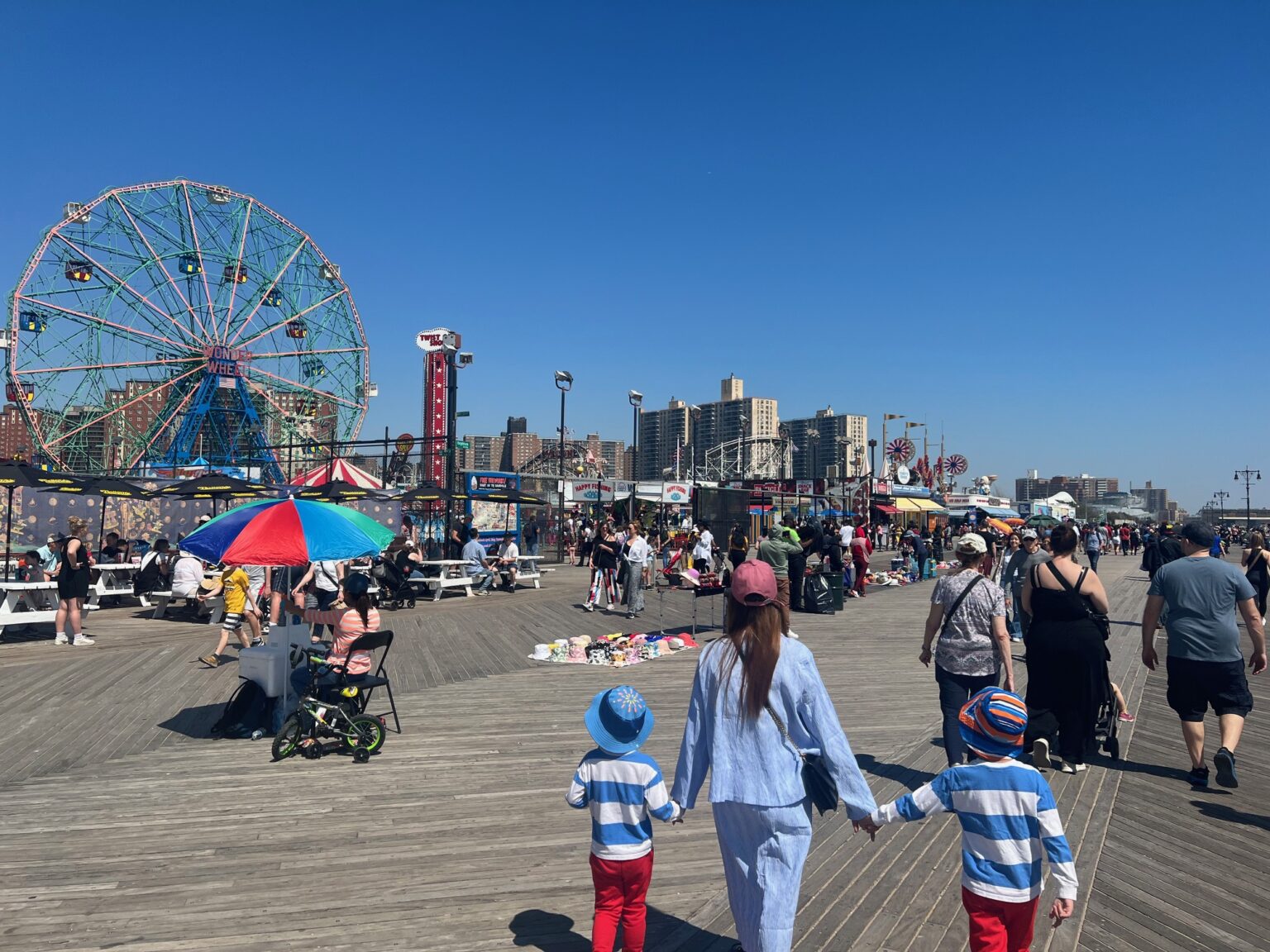
Coney Island is a seasonal destination. If you are visiting between Memorial Day and Labor Day, the amusement parks (Luna Park and Deno’s Wonder Wheel) are open daily. During the "shoulder season" (April, May, September, and October), they are often only open on weekends. In the winter, the boardwalk remains a beautiful place for a walk, but the rides are closed.
Accessibility Considerations
The Coney Island-Stillwell Avenue station is fully ADA-accessible with elevators. However, older stations near the Brooklyn Bridge, such as York Street (F), have historically lacked elevator access. If you require an elevator, use the Jay Street-MetroTech or DeKalb Avenue stations, which are equipped with modern accessibility features as of 2026.
Safety and Weather
In 2026, the MTA has increased its "Live Station" monitoring. Always check the MTA Weekender app or website before heading out, as track maintenance is common. If you are cycling, the Ocean Parkway path is well-lit, but avoid riding late at night if you are unfamiliar with the area. Ensure you have plenty of water, as the ride from Downtown Brooklyn to the shore offers limited shaded rest areas.
Using OMNY for Fare Capping
If you plan to use multiple transit modes (Subway and Bus) throughout the day, use the same credit card or device for all OMNY taps. In 2026, the MTA continues its "Lucky 13" fare-capping program. After your 12th paid ride in a week (starting Monday), all subsequent rides are free. While a single trip to Coney Island won't trigger this, it is a valuable benefit for those spending a full week exploring New York.
Frequently Asked Questions
Which subway station is closest to the Coney Island Boardwalk?
While Stillwell Avenue is the main terminal, the West 8th Street-New York Aquarium station (served by the F and Q trains) is actually the closest to the beach and the aquarium entrance. It features a scenic pedestrian bridge that leads directly over Surf Avenue to the Boardwalk.
Is it safe to take the subway to Coney Island late at night?
Yes, the subway runs 24/7. However, the trip takes longer late at night due to less frequent service. During the summer, trains are often crowded with people leaving the beach or concerts at the Ford Amphitheater, providing a "safety in numbers" environment. Always stay in the middle cars or the car with the conductor if you feel uneasy.
Can I bring a bicycle on the subway?
Yes, you can bring bicycles on New York City subways at any time, but you should avoid peak rush hour (7:00 AM – 9:00 AM and 4:00 PM – 6:30 PM) out of courtesy to other passengers. Use the ends of the train cars to provide more space for your bike and other riders.
Are there express trains to Coney Island?
The Q train operates as an express in Brooklyn on weekdays, skipping several local stops between Atlantic Avenue and Kings Highway, which can save 10–15 minutes. The F train is almost always a local service. Occasionally, the D and N trains run express depending on the time of day and track work.
How much should I budget for a full day trip?
Beyond the $6.00 round-trip transit cost, a typical day at Coney Island in 2026 might include:
- Lunch (Nathan's Famous): $15–$25
- Amusement Park Wristband: $65–$80
- Beach Snacks/Drinks: $10–$20 A budget of $100–$130 per person covers most activities and food comfortably.
Recommendation for Next Steps
For most travelers, the Q train from DeKalb Avenue remains the gold standard for reaching Coney Island from the Brooklyn Bridge. It balances cost, speed, and the quintessential experience of seeing the Brooklyn skyline transition into the Atlantic horizon. Before you depart, download the MTA MyMTA App to check for real-time delays or service changes, which are common on weekends. If you have the stamina, consider taking the subway down and using a rideshare back to the bridge area after sunset to enjoy the evening lights of the Belt Parkway and the Verrazzano Bridge.